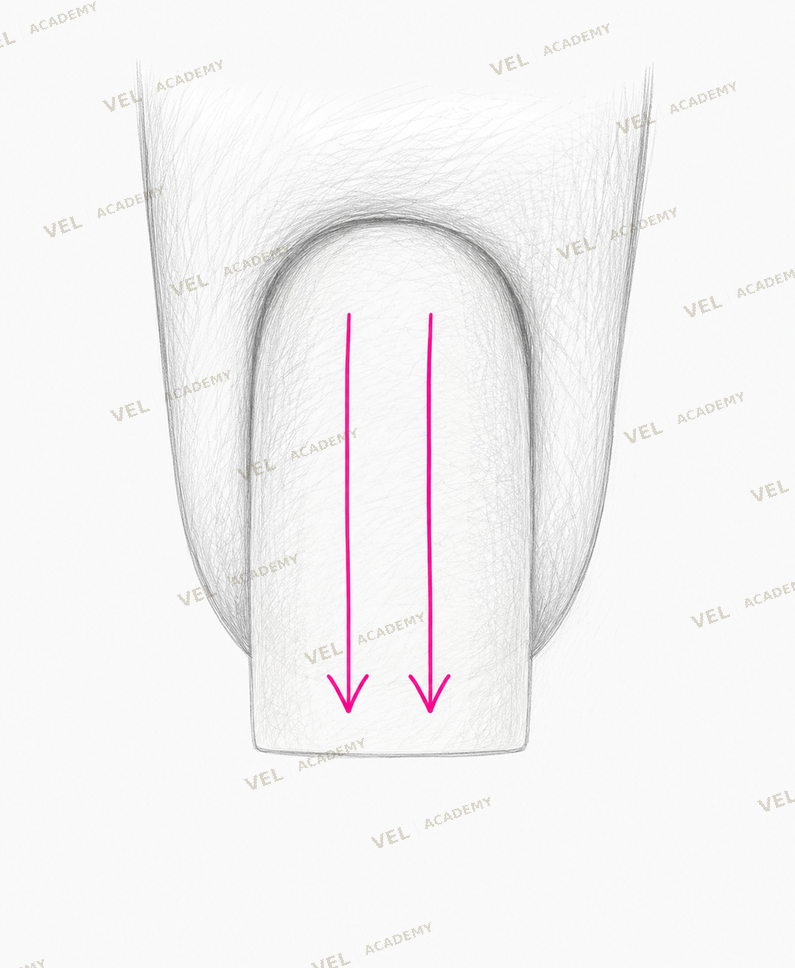
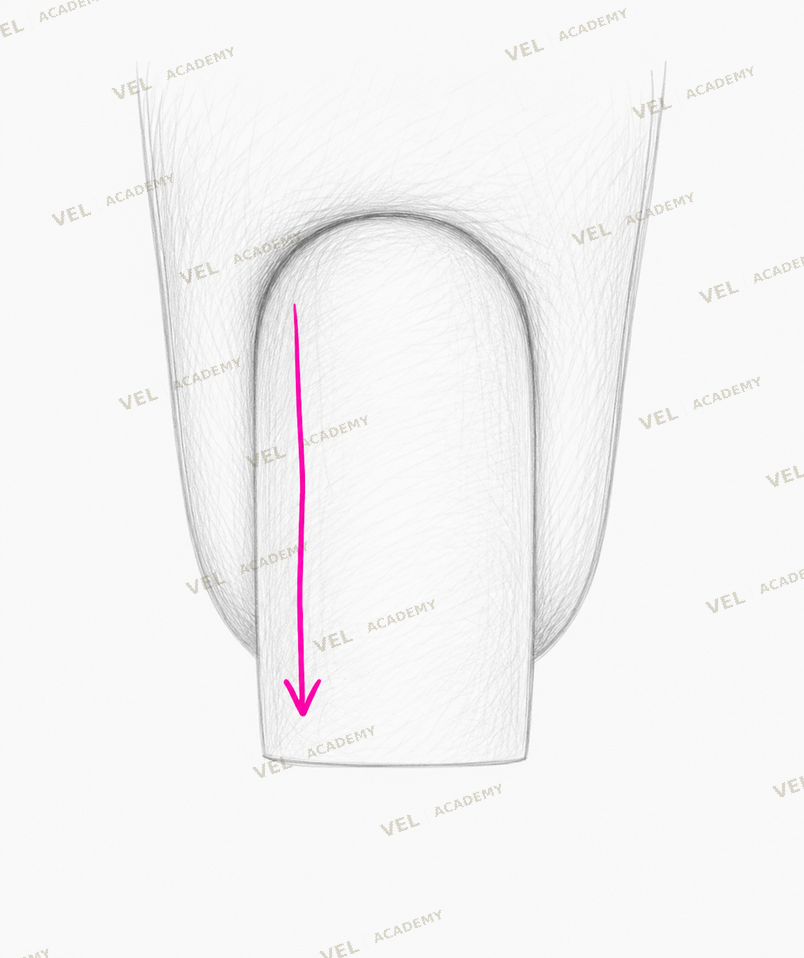
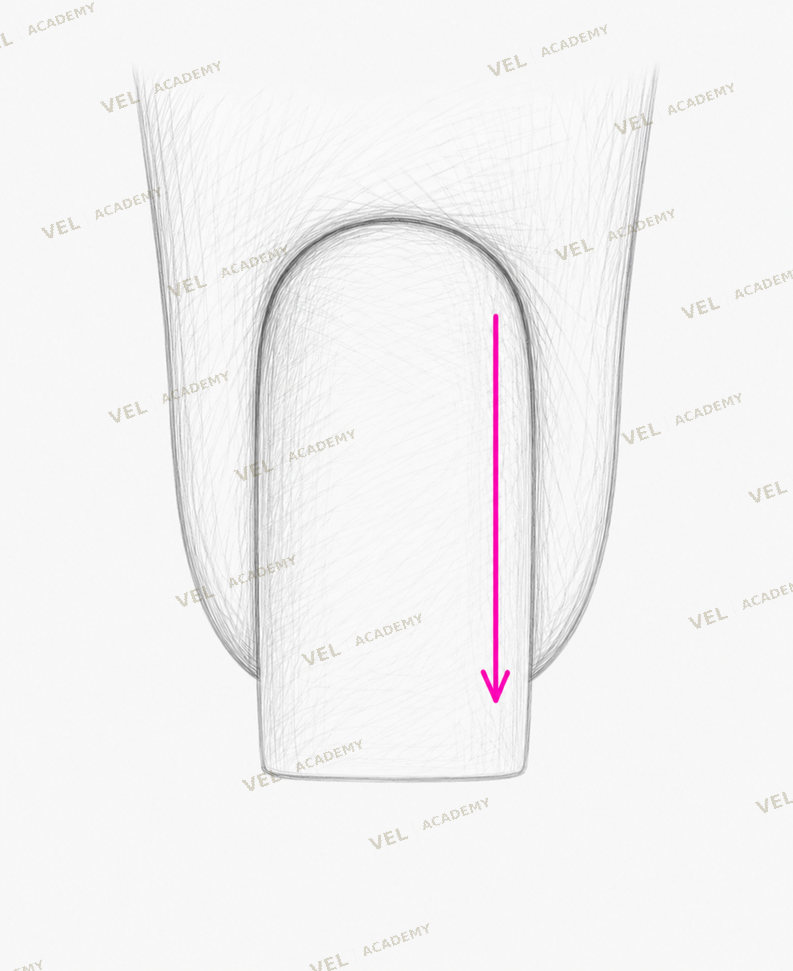
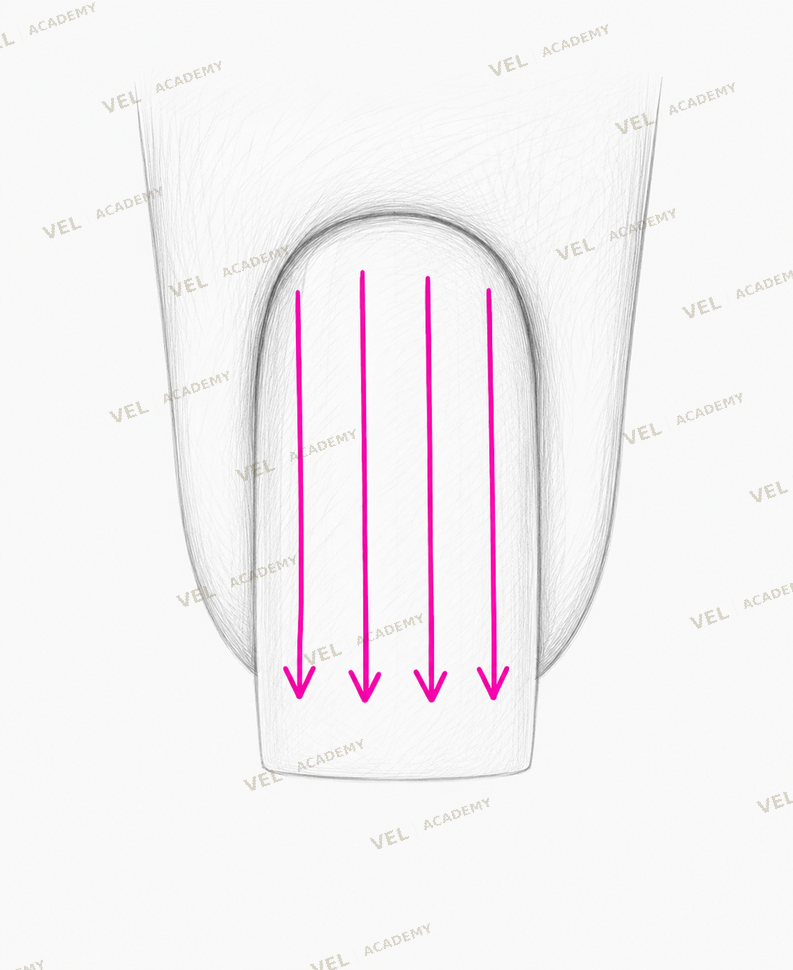
The 5 Strokes: Zone, Function, and Technique
Stroke 1 — Center
One stroke down the center of the nail plate from just below the cuticle line to the free edge. This establishes the baseline product amount and confirms brush load before moving to the lateral zones. The center stroke is the reference point — subsequent strokes should match its thickness.
Stroke 2 — Left Lateral Wall
The brush is angled to press lightly against the left lateral wall — not applied from above. The stroke runs from the sinus zone toward the free edge, sealing the left edge of the nail. This angle is critical: if the brush is held flat and pulled across the top of the nail toward the left wall, the product thins at the wall rather than building coverage there.
Stroke 3 — Right Lateral Wall
Mirrors stroke 2 on the right side. Consistent pressure and brush angle on both walls creates a symmetrical base layer — the foundation for even leveling gel distribution in the next stage. Asymmetrical base coat thickness at the lateral walls is one of the hidden causes of uneven nail shape after leveling gel is filed.
Stroke 4 — Cuticle Zone
The most technically precise stroke of the five. The brush is positioned to coat just up to the cuticle line — not over it. By this point the brush has delivered product to three zones and is less loaded than it was at stroke 1. This natural reduction in product load is part of why the cuticle zone comes fourth: less product on the brush means less risk of flooding the cuticle skin. The stroke runs along the cuticle line in one smooth movement.
Stroke 5 — Surface Smooth and Free Edge Seal
A final smoothing stroke from the growth zone to the free edge, finishing by wrapping the free edge. This stroke levels any minor thickness differences between the previous four strokes and seals the tip of the nail. Wrapping the free edge is what prevents tip chipping — the most common client complaint after a gel fill. A base coat that does not wrap the tip leaves the coating edge unsealed and vulnerable to mechanical separation from the free edge inward.
Why Lateral Walls Come Before the Cuticle Zone
The stroke order — center, left wall, right wall, cuticle zone, free edge — is not arbitrary. The lateral wall strokes require pressing the brush against the wall surface, which pushes a small amount of product inward toward the center of the nail. If the cuticle zone stroke were applied before the lateral walls, that inward push during the wall strokes would move product into the cuticle area and flood it.
By covering the walls before the cuticle zone, the inward push from strokes 2 and 3 goes toward the center of the nail — where additional product is absorbed without creating a problem. The cuticle zone stroke then addresses a clean zone with a brush that has already delivered most of its load to the previous three areas.
The sequence is a system: each stroke in the 5-stroke scheme prepares the conditions for the next. Stroke 1 sets reference thickness. Strokes 2 and 3 seal the highest-risk lifting zones. Stroke 4 addresses the cuticle with a less-loaded brush. Stroke 5 seals the surface and the free edge. Changing the order changes the conditions and degrades the result — which is why VEL Academy treats the sequence as fixed.
Common Errors in Base Coat Application
- Applying from the cuticle outward rather than starting with the center — creates a thick cuticle zone and thin lateral walls
- Holding the brush flat for lateral wall strokes — coverage thins at the wall rather than building it
- Skipping the free edge wrap on stroke 5 — leaves the tip unsealed and vulnerable to chipping
- Over-loading the brush for stroke 4 — floods the cuticle zone and causes growth-zone lifting within days
- Not waiting for the previous product to settle before applying acid base and base coat — disrupts the acid base layer and reduces adhesion
The cuticle flooding problem: flooding the cuticle zone with base coat does not just cause lifting — it creates a visible colour boundary at the cuticle as the fill grows out. Clients notice this as a "gap" appearing at the cuticle within the first week. The solution is always in stroke 4 technique, not in the product.
Frequently Asked Questions
How many brush strokes does the base coat application use in Russian manicure?
VEL Academy recommends a 5-stroke scheme: center, left lateral wall, right lateral wall, cuticle zone, and free edge seal. Each stroke covers one specific zone — together they ensure full coverage with no thin spots and no flooding.
Why do the lateral walls come before the cuticle zone?
Lateral wall strokes push a small amount of product inward. If the cuticle zone were addressed first, this push would flood it. Covering walls before the cuticle zone means the inward push goes toward the center — where it is absorbed without issue.
Why is wrapping the free edge with base coat important?
The free edge is the most exposed zone — unsealed, the coating edge separates from the tip inward under mechanical impact and water exposure. Stroke 5 always finishes by wrapping the free edge — this is the primary prevention for tip chipping.
How do you apply base coat to the cuticle zone without flooding it?
By making the cuticle zone the fourth stroke — after center and both walls have already used most of the brush load. The less-loaded brush at stroke 4 naturally reduces flooding risk. The stroke runs along the cuticle line in one smooth movement without pressing into the skin fold.
Does base coat need to cover the full nail plate in Russian manicure?
Yes. In VEL Academy technique, base coat covers the full nail plate — including lateral walls and the cuticle zone. Partial coverage creates weak adhesion zones that become lifting starting points.