The Technique: Application, Flip, Wait, Cure
Step 1 — Apply Top Coat
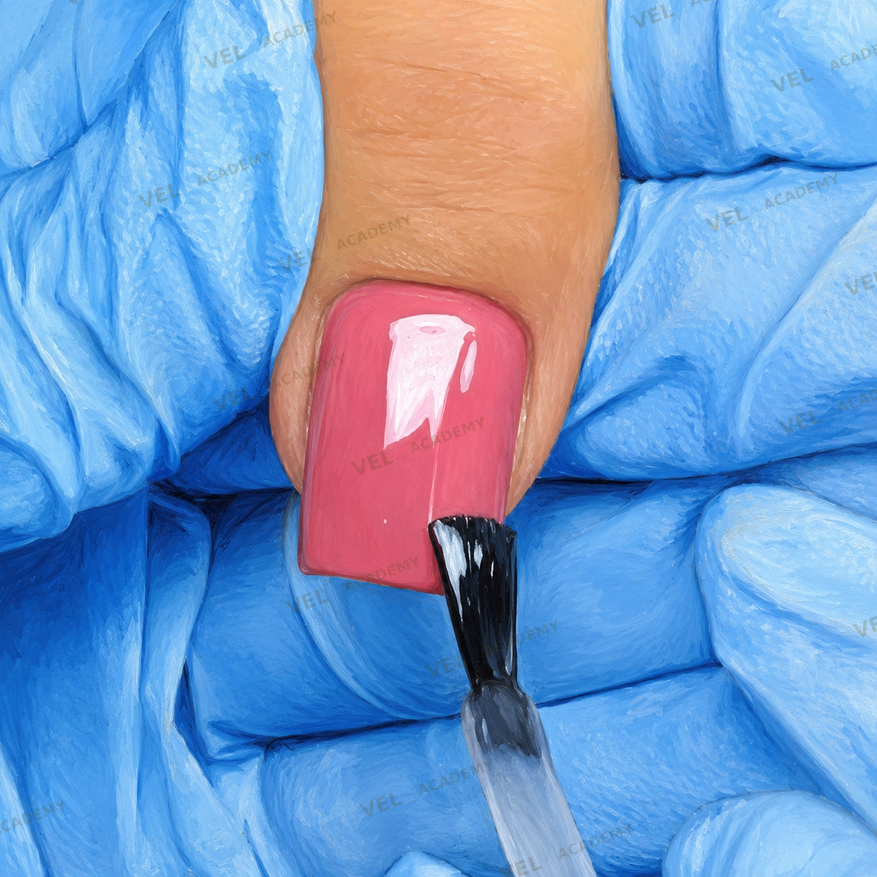
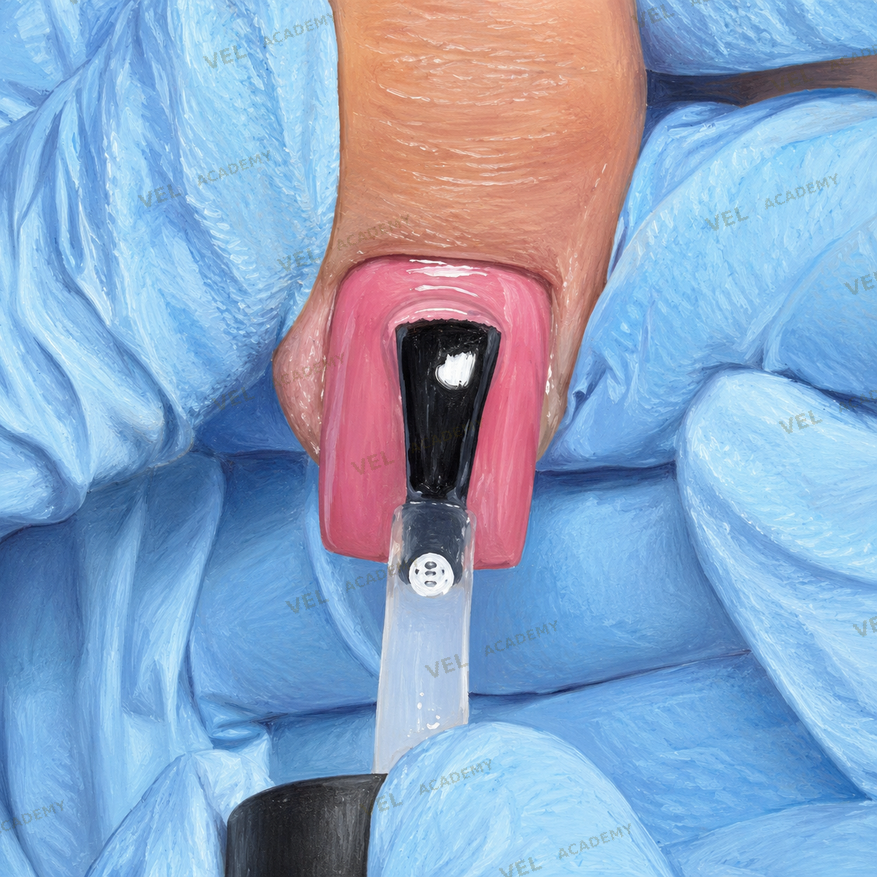
Apply top coat with a lightly loaded brush using smooth, even strokes across the full nail surface including the free edge. The brush load should be enough to cover the nail evenly without pooling — the same squeezed brush principle used in the first colour layer. Do not attempt to eliminate brush marks at this stage; the flip step handles that.
Step 2 — Flip the Hand
Immediately after applying top coat to all nails on the hand, flip the hand so the nails face downward. This is done in one smooth movement — no hesitation between the last application stroke and the flip. The sooner the hand is flipped after the last nail, the longer all nails have in the self-leveling position.
Step 3 — Wait 5 Seconds
Hold the hand in the flipped position for 5 seconds. During this time, the top coat flows under gravity into an even layer. Brush marks fill in, high spots flow toward low spots, and the surface becomes smooth and reflective. No brush contact during this step — touching the product reintroduces marks.
Step 4 — Cure
After 5 seconds, move directly to the lamp. Do not re-flip the hand to nails-up before curing — this would reverse the self-leveling effect. Place the hand in the lamp with nails still facing downward if the lamp design allows, or flip to nails-up as quickly as possible and cure immediately.
Why 5 Seconds Is the Right Window
Five seconds is enough time for the top coat to self-level and for brush marks to fill in at standard top coat viscosity. Less than 5 seconds does not give the product enough time to fully settle. More than 5 seconds risks the product beginning to set slightly at the surface — which reduces the smoothness of the self-leveling effect — or, with very fluid top coats, risks product flowing past the free edge.
The 5-second recommendation in VEL Academy technique is calibrated to the two top coat products used in the course: One Nail Fix and IQ Beauty. Other products with significantly different viscosities may require adjustment. A very fluid top coat may self-level in 3 seconds; a thicker product may need 6 or 7.
What the technique requires from the product: the hand flip works best with a top coat that has enough body to stay on the nail in the flipped position without dripping, and enough flow to self-level the brush marks within the 5-second window. If the product drips during the flip, the brush was overloaded — not the technique wrong. Reduce brush load and try again.
The Result: What a Mirror Finish Actually Means
A mirror finish is not just glossy — it is smooth enough to reflect a clear image. The difference between a high-gloss finish with visible brush texture and a true mirror finish is tactile as well as visual: run a fingernail lightly across the surface after curing and the mirror finish feels completely smooth, with no ridges or texture at all.
This finish quality is one of the visible markers of Russian manicure technique that clients notice and mention to other clients. It is not achievable consistently with brushwork alone — the hand flip technique is what makes it reproducible across every nail and every appointment.
Frequently Asked Questions
Why do you flip the hand after applying top coat?
Flipping the hand uses gravity to self-level the top coat into an even layer, eliminating brush marks without additional brush work. In VEL Academy technique, 5 seconds in the flipped position produces a mirror finish that brushwork alone cannot achieve consistently.
How long do you hold the hand flipped?
VEL Academy recommends 5 seconds — long enough for self-leveling, short enough that the product does not begin to set or drip. Very fluid top coats may need slightly less; thicker products slightly more.
Does the top coat drip when the hand is flipped?
A correctly loaded brush produces a layer thin enough to self-level without dripping in 5 seconds. If the product drips, the brush was overloaded. Squeeze excess off the brush before application — the same principle as the first colour layer.
What top coat does VEL Academy recommend?
VEL Academy courses use One Nail Fix glossy top coat and IQ Beauty matte top coat. Both are applied with the hand flip technique. IQ Beauty matte requires an additional fine brush cuticle zone pass — covered in the matte top coat article.
Do you need to wipe the top coat after curing?
It depends on the product. Some top coats cure with a sticky inhibition layer requiring cleanser after curing. Others cure fully dry. Check the product specification and use the correct cleanser to avoid dulling the finish.