Coating Removal · E-File Technique
Gel Coating Removal with an E-File: The 6-Stroke Scheme Explained Step by Step
VEL Academy methodology: The 35,000 RPM setting and 6-stroke removal scheme described in this article are the approach VEL Academy recommends for fast, consistent coating removal. Different manufacturers, machines, and schools may use different speeds or sequences. The figures given here are specific to the VEL Academy system — calibrate them to your equipment and the guidelines of your training.
Speed in gel coating removal does not come from moving faster — it comes from moving in the right sequence. The 6-stroke removal scheme at 35,000 RPM divides the nail plate into zones and clears each one with a specific stroke direction. Once you understand why each stroke is placed where it is, removal becomes a repeatable, predictable process rather than an improvised scan of the nail surface.
Why a Defined Removal Scheme Matters
Most nail technicians learn removal by feel: they move the e-file across the nail until the coating looks thin, then stop. This approach works well enough when you have time, but it has two structural problems. First, it is inconsistent — some zones get more passes than others without any particular reason, leading to uneven thinning. Second, it is slow, because without a defined path, the bit covers the same territory multiple times and misses other areas entirely.
A defined 6-stroke scheme solves both problems. Each stroke covers a specific zone, in a specific direction, for a specific purpose. When you follow the scheme, every nail gets the same removal quality regardless of how you feel at a particular appointment. And because no zone is skipped or doubled, the total number of passes is minimized — which is where the time saving comes from.
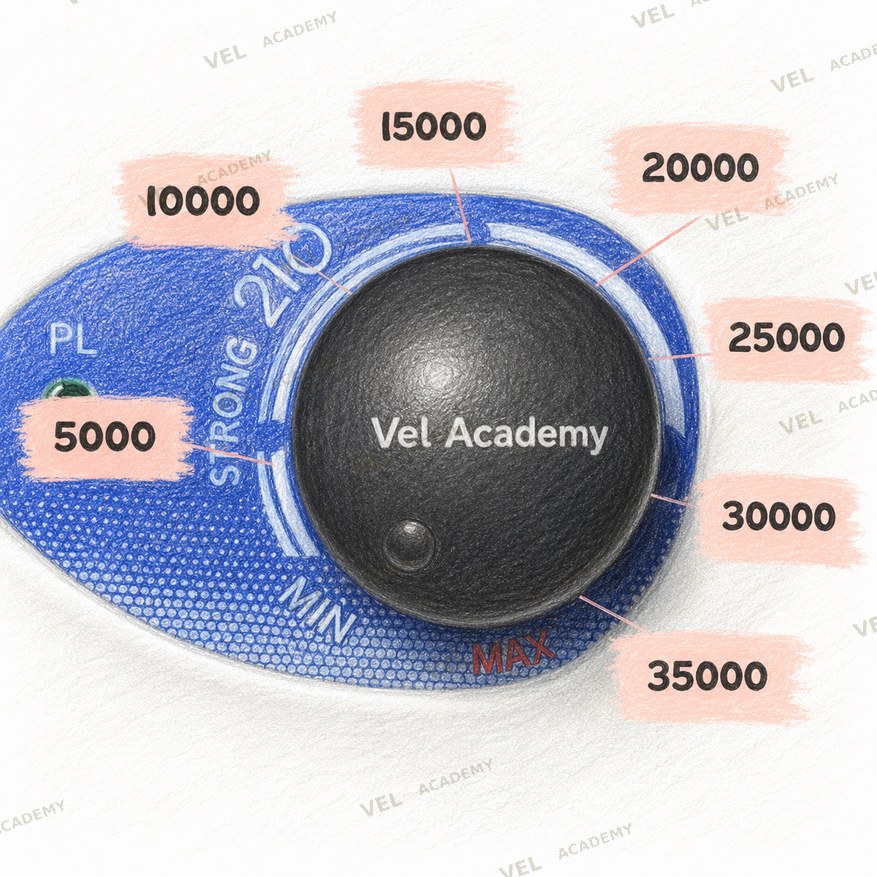
The removal stage runs at 35,000 RPM — the setting that makes the 6-stroke scheme work efficiently
The Setup: Bit, Speed, and Rotation Direction
Before the first stroke, three parameters must be correct:
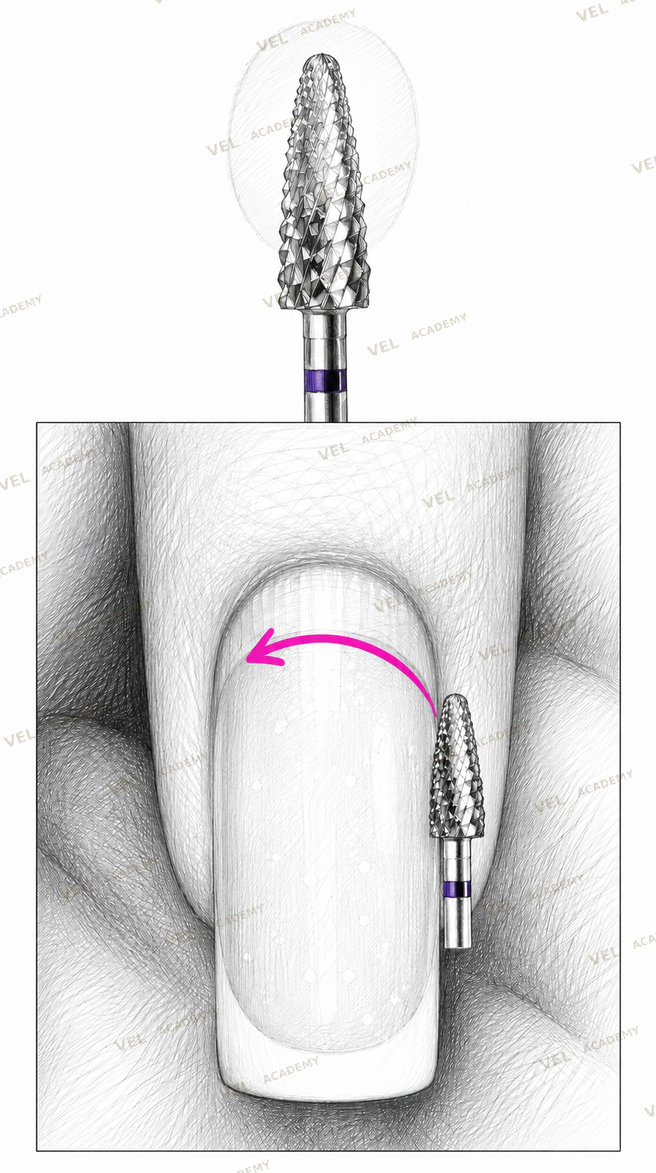
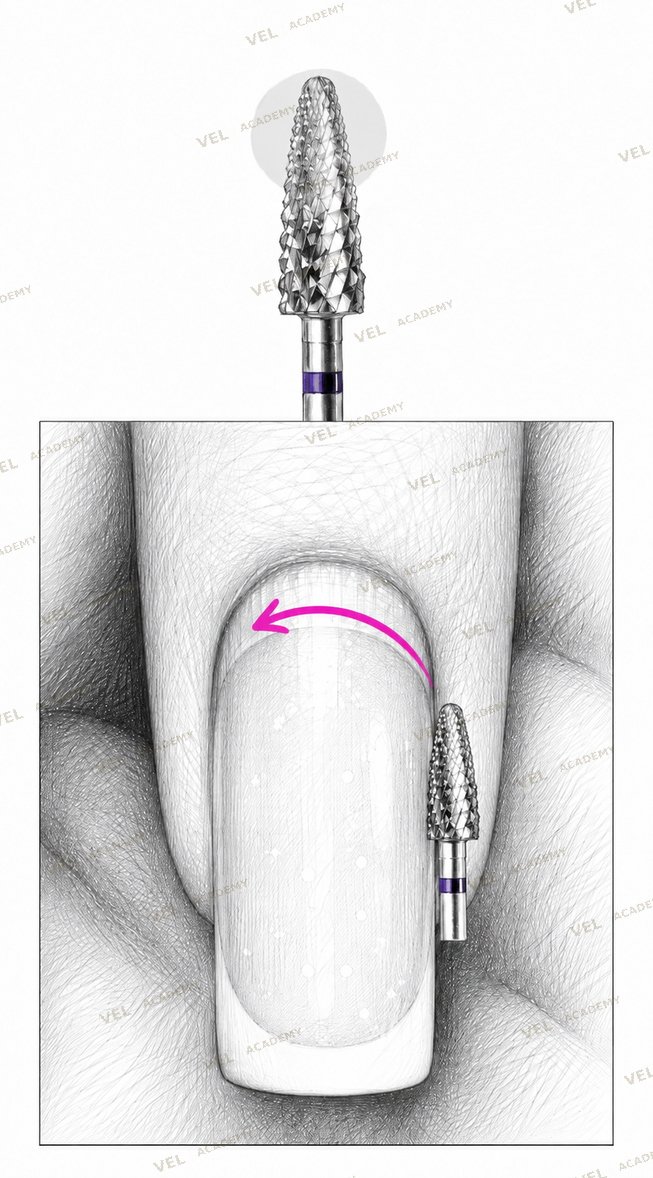
- Bit shape: straight carbide bit only — Pro Burs №411, Kristall 31235, or equivalent. Tapered bits are not used for removal.
- Speed: 35,000 RPM. This is the speed at which a straight carbide bit removes gel coating efficiently without requiring additional pressure.
- Rotation: FWD (forward) for standard removal strokes. The cutting edges of a standard straight bit are optimized for forward rotation.
With these three parameters set correctly, the bit does the work. You control direction and zone — the bit handles removal rate and heat management.

Pro Burs №411 — purple grit straight carbide bit
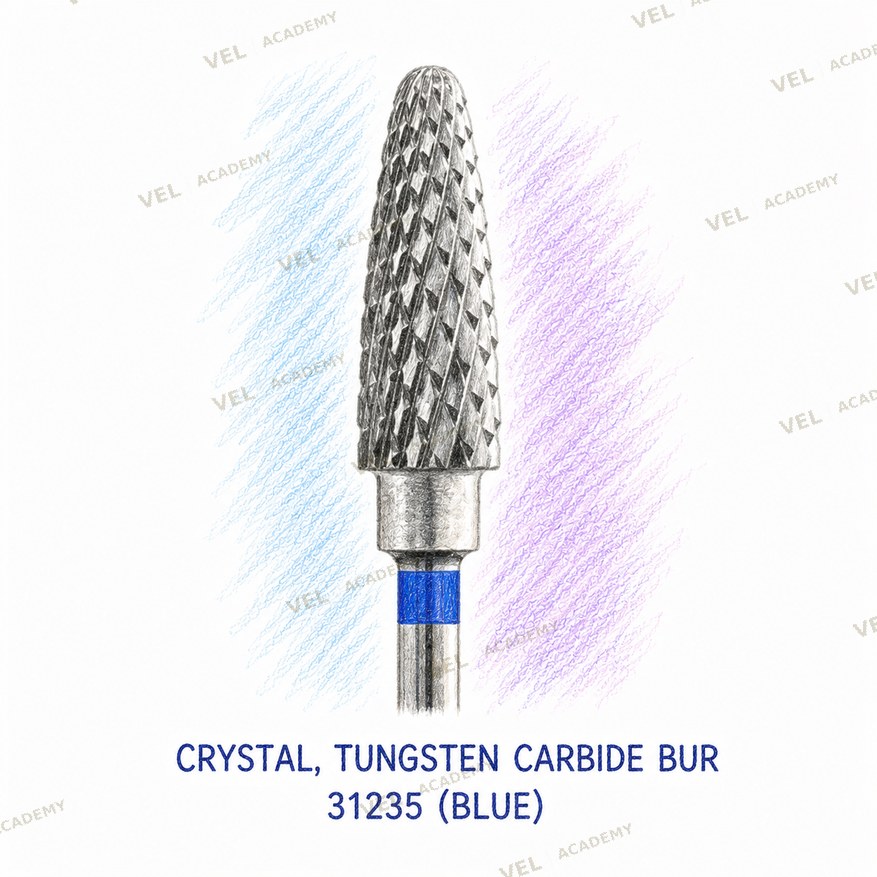
Kristall 31235 — blue grit straight carbide bit

Kristall 13236 — left hand bit for specific stroke directions
The 6-Stroke Removal Scheme: Zone by Zone
The nail plate is not a uniform surface. The coating is thickest at the free edge and stress zone, thinner at the growth zone near the cuticle, and variable across the lateral walls depending on how base coat and leveling gel were applied. The 6-stroke scheme accounts for this variation by assigning each zone its own approach.
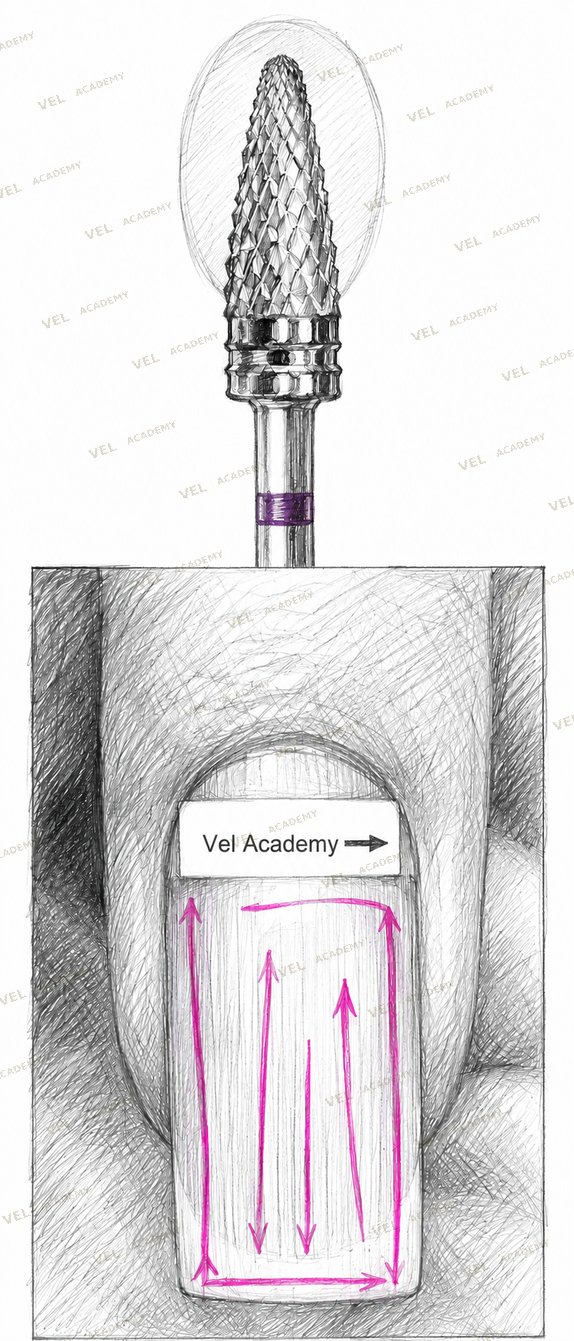
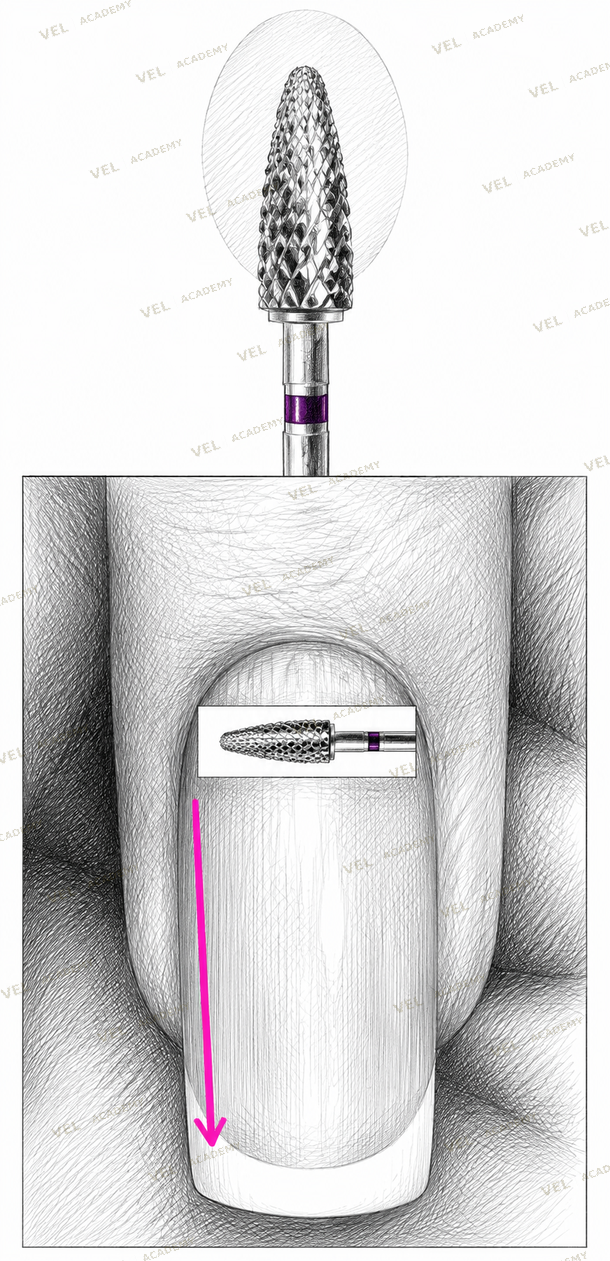
Strokes 1–3: free edge and lateral zones
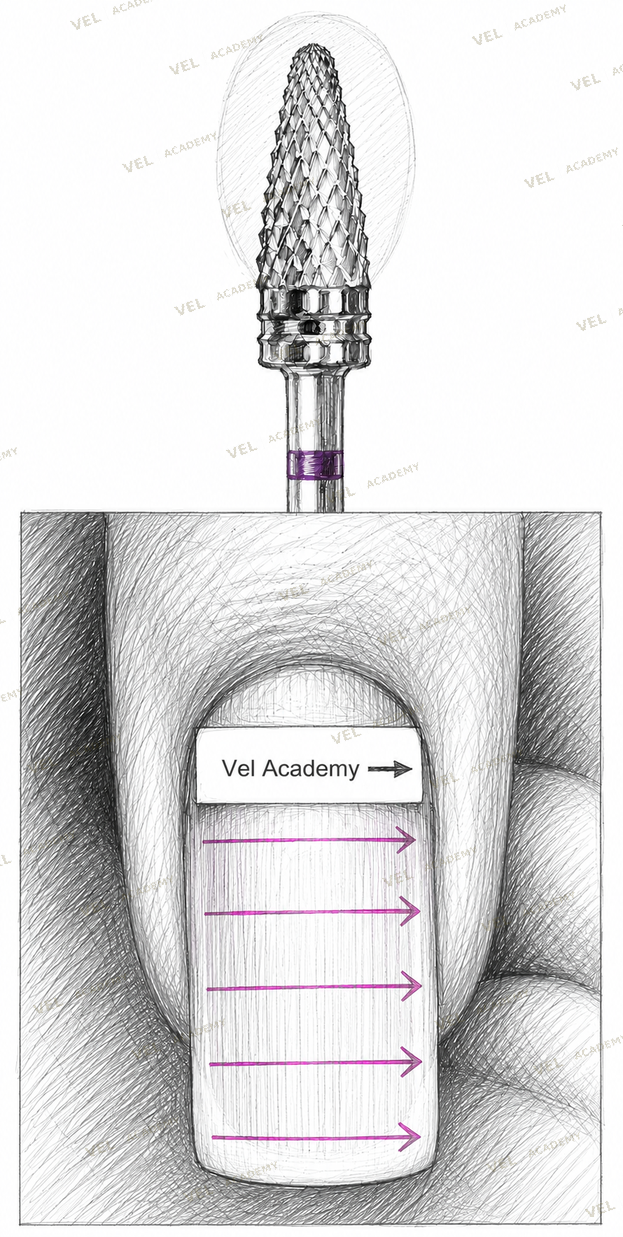
Strokes 4–6: center and growth zone
Stroke 1
Free edge — tip approach. The first stroke clears the thickest zone: the free edge where coating has been wrapped and built up. The bit moves from the tip inward, clearing the edge before approaching the thinner zones closer to the cuticle.
Stroke 2
Right lateral wall — longitudinal stroke. The bit travels from free edge toward the growth zone along the right lateral wall, clearing the coating that runs along the side of the nail where it was applied under the lateral overhang.
Stroke 3
Left lateral wall — longitudinal stroke mirroring stroke 2. Both lateral walls are cleared before moving to the center of the nail, which prevents the bit from redistributing coating from the walls into the center zone during the central strokes.
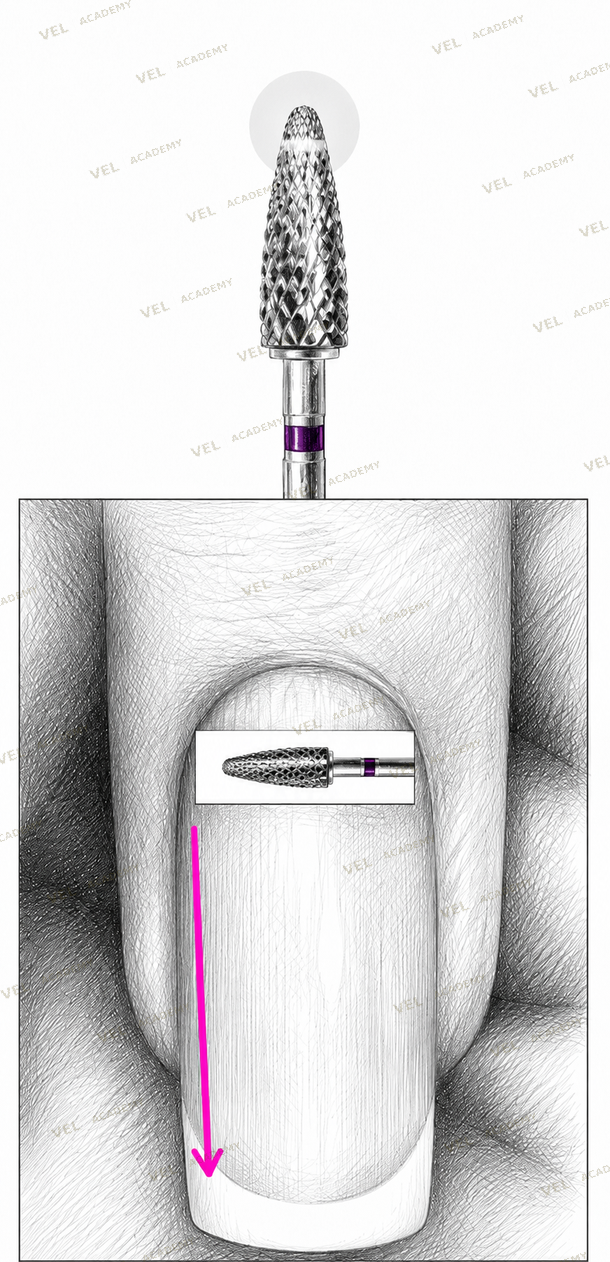
Stroke 4
Center — longitudinal stroke from free edge toward growth zone. This is the widest coverage stroke and clears the main body of the coating. By this point the lateral walls and free edge have been reduced, so the center stroke does not encounter significantly thicker material at the edges.
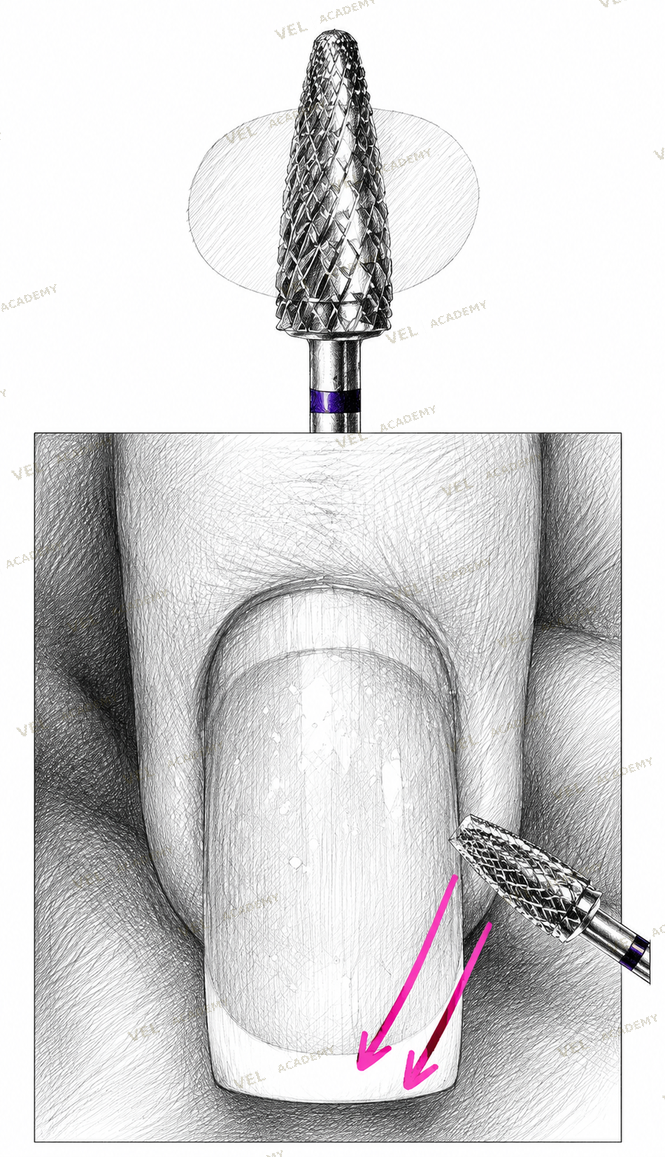
Stroke 5
Diagonal stroke — right to left across the nail at approximately 45°. This stroke catches the material that the longitudinal strokes left at the transitions between zones — particularly at the stress zone where the arch of the coating is highest.
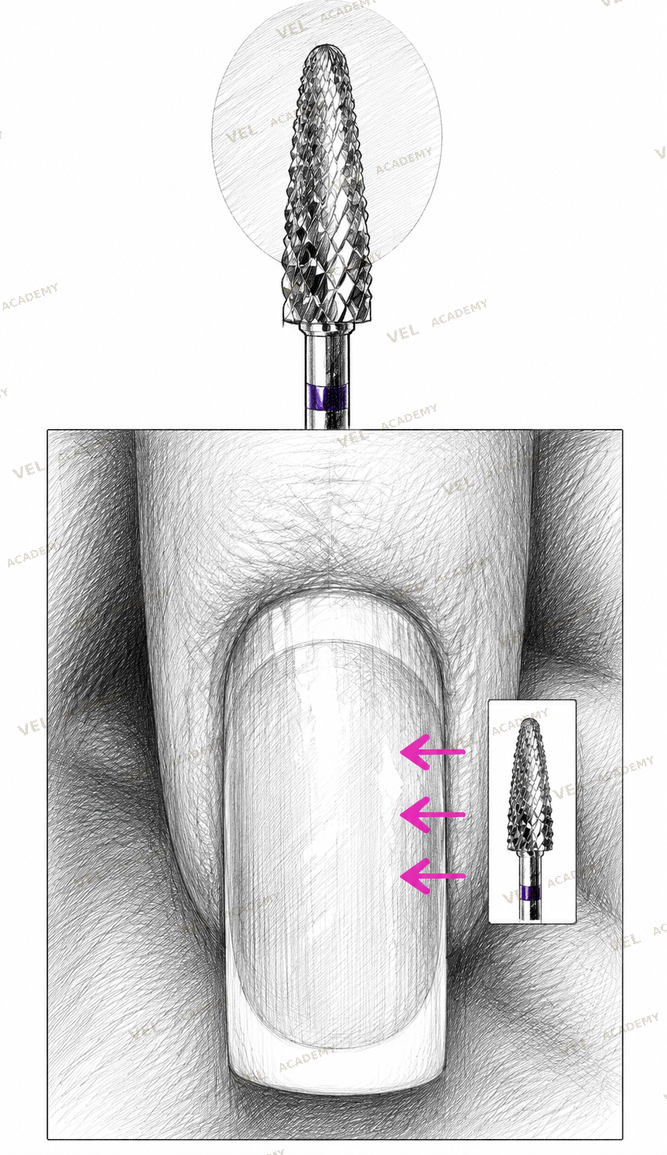
Stroke 6
Growth zone — final controlled pass closest to the cuticle. This is the most careful stroke of the sequence. The coating is thinnest here and the nail plate closest to the surface. The bit moves laterally (side to side) rather than longitudinally to maintain control and avoid going through the residual coating.
How Much to Remove: The Correct Endpoint
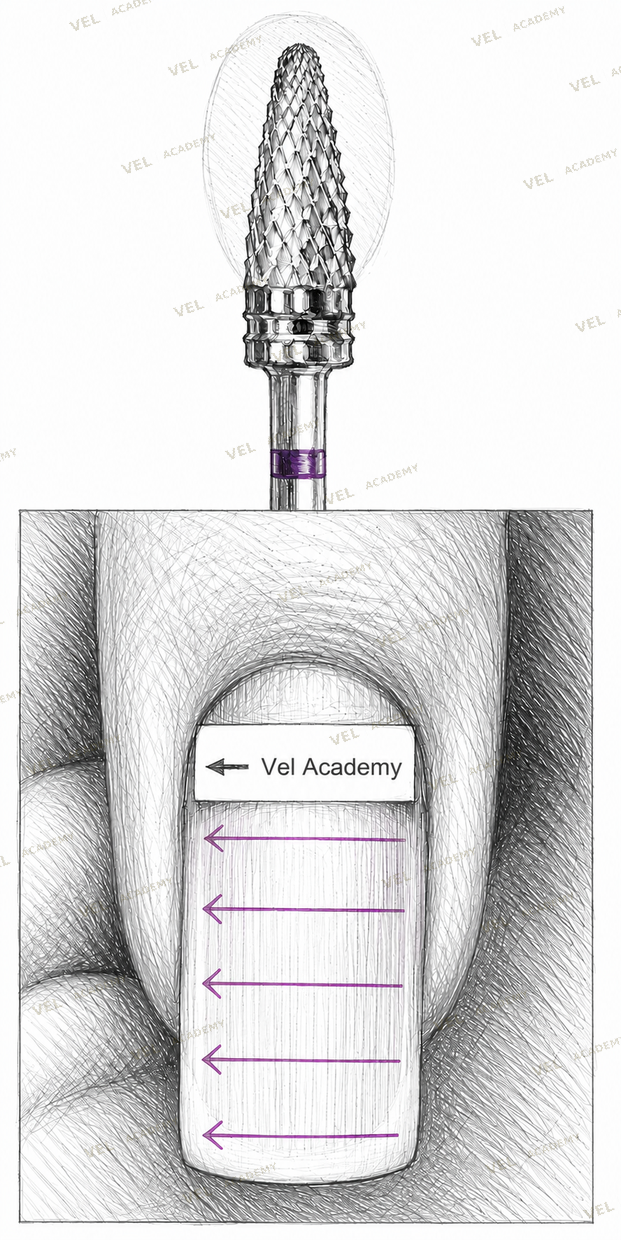
Correct removal result: thin even residual layer remaining, heaviest from growth points toward free edge
The endpoint of the removal stage is not a bare nail plate — it is a thin, even residual layer of coating. The coating should be reduced to the point where it is semi-transparent and even across the nail, with the thickest remaining material concentrated from the growth points toward the free edge.
This thin layer serves a purpose: it protects the nail plate surface from abrasion during the remaining removal passes and provides a slight tooth for the base coat that will be applied after manicure. Removing it completely by pushing through to the raw nail plate is not an improvement — it is an over-step that thins the natural nail over time.
The rule: remove coating down to a thin layer, with material predominantly remaining from the growth points to the end of the free edge. If you can see through the residual layer to the natural nail color, you have reached the correct depth. If the nail plate surface is shiny and clearly exposed, you have gone too far.