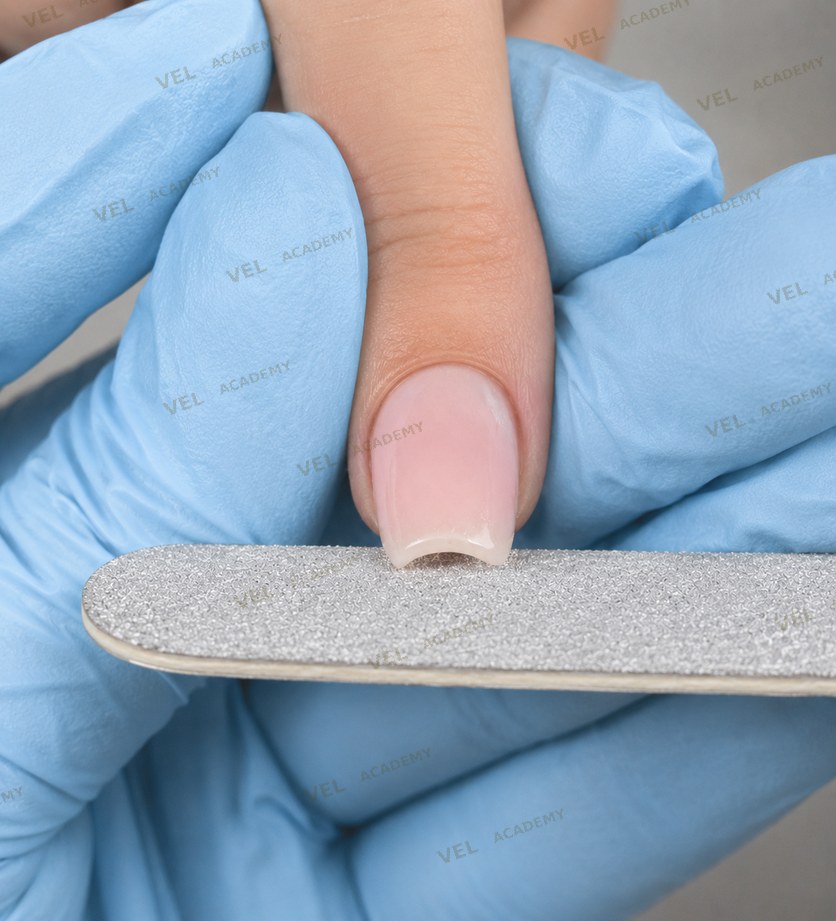
The Visual Alignment Technique
The alignment check in VEL Academy technique is performed by looking at the nail from above and comparing the visible overhang on each lateral wall. The goal is not to measure precisely — it is to identify which side has more overhang and by approximately how much.
Once the asymmetry is identified, file the side with more overhang until both sides match visually. This alignment filing is not shape filing — it is preparation. The strokes are parallel to the lateral wall, removing overhang only, without rounding or squaring the free edge.
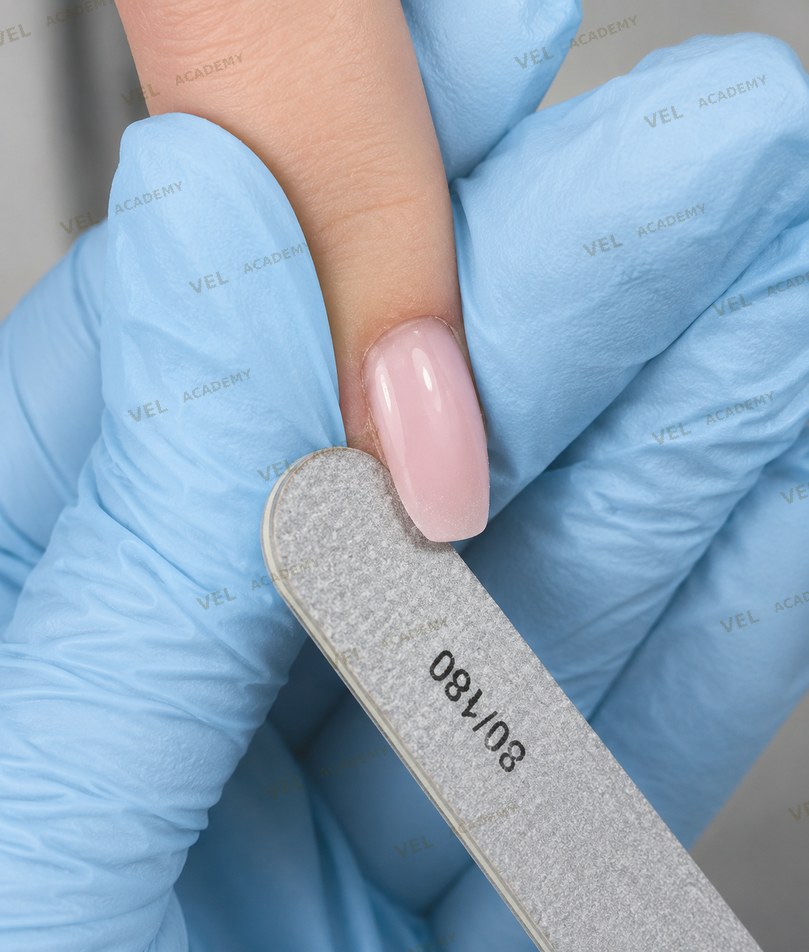
Aligning right lateral overhang to match left
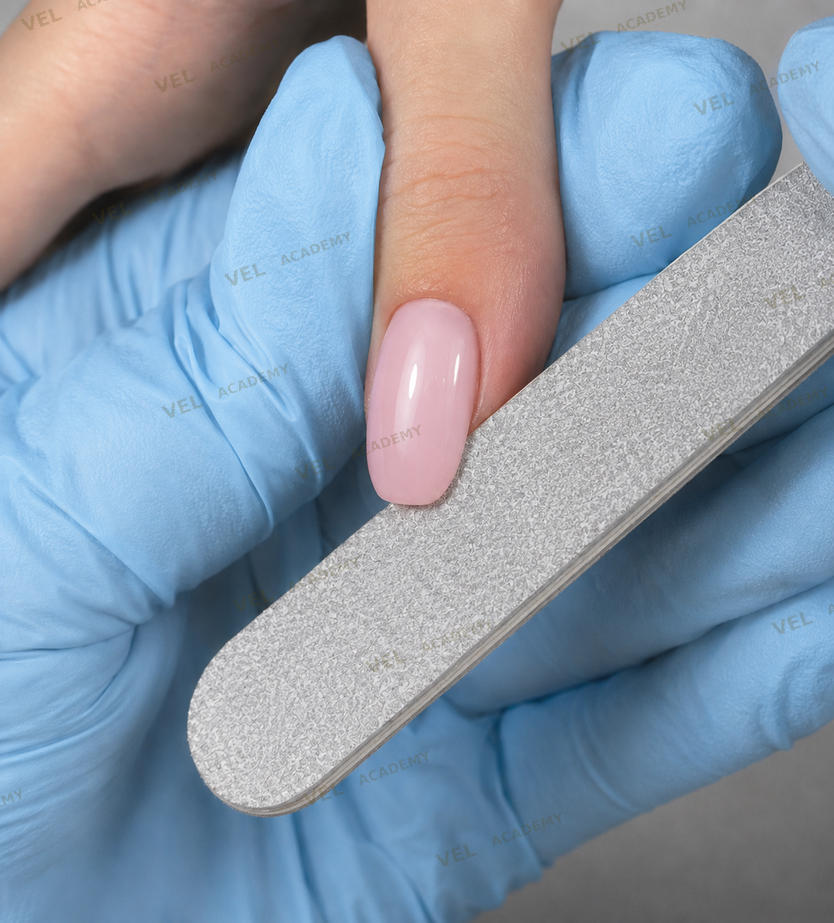
Left lateral overhang — brought to same level as right
After alignment, look at the nail from above again. Both overhangs should appear equal. Only at this point does shape filing begin — oval rounding or square free edge filing, depending on the client's requested shape.
Why Asymmetry Cannot Be Corrected After Shape Filing Begins
For oval shapes: once the free edge rounding begins, the visual reference points change. The apparent width of the nail changes as the corners are rounded, making it impossible to compare lateral overhangs reliably against each other. Filing more from one side during the rounding process to compensate for pre-existing asymmetry produces a shape that is uneven in a different way — one side of the oval arc is longer or tighter than the other.
For square shapes: the lateral overhang removal steps in the square sequence are designed around symmetrical starting points. If one side has significantly more overhang than the other, the flat lateral filing strokes remove different amounts from each side — and the result is a square shape where the nail appears wider on one side than the other, even though the filing technique was applied correctly.
The 30-second investment: the overhang alignment check takes approximately 30 seconds — identify the asymmetry, file the side with more overhang, check again. Skipping this step costs more than 30 seconds in correction work after shape filing reveals the asymmetry — correction that is often impossible to complete without removing more length than the client wanted. In VEL Academy technique, the alignment check is always faster than its alternative.
Common error: beginning shape filing on the side with less overhang first, then attempting to match it on the other side during the shape filing steps. This approach reverses the correct sequence — it applies shape filing technique to material that should have been removed in the alignment step, creating an inconsistency in the shape that accumulates across both sides rather than resolving it.
Why defined sequences produce faster results: In VEL Academy Russian manicure technique, every stage of the service — including shape filing — follows a defined step sequence. This is not about working faster within each step. It is about eliminating the reassessment, backtracking, and correction work that improvised filing produces. The cumulative effect of removing unnecessary work across every stage is the up to 30% service efficiency improvement that VEL Academy technique delivers.
Applying Alignment to Both Shapes
In the oval shape sequence, overhang alignment is step 2 — explicitly placed between length shortening and lateral overhang removal. In the square shape sequence, it is an implicit prerequisite to step 1 (free edge at 90°). In both cases, the principle is the same: equal overhangs before shape filing, checked visually, corrected by filing the side with more overhang until both match.
This one step, applied consistently, is what makes both oval and square shape results reproducible across different clients and different appointments — not technique improvisation, and not correction after the fact.
Frequently Asked Questions
How do you align coating overhang on both sides before filing?
Look at the nail from above and compare overhang on both lateral walls. File the side with more overhang until both sides match visually. Only when both overhangs are equal does shape filing begin.
Why can't overhang asymmetry be corrected after shape filing begins?
For oval, rounding changes the visual reference points making overhang comparison unreliable. For square, the lateral wall strokes work from a symmetric starting point — asymmetry built into the pre-shape overhang is amplified rather than corrected by the filing technique.
How much overhang should be left before shape filing?
VEL Academy does not specify a fixed amount — it depends on desired shape and nail geometry. What matters is that both sides have equal overhang before shape filing begins.
Does overhang alignment apply to both oval and square shapes?
Yes. It is step 2 in the oval sequence and an implicit prerequisite for square. Both shapes depend on a symmetrical starting point for the filing technique to produce a symmetrical result.