Restoration · Filing and Deformation Assessment

Square Filing After PolyGel Restoration and Identifying Nail Deformation: Two Skills That Work Together

VEL Academy methodology: The post-restoration filing sequence and deformation assessment framework described in this article are specific to VEL Academy's Problem Nails Masterclass technique. The 6-step e-file sequence after PolyGel restoration differs from standard square filing — understanding why each step is different is what makes the sequence work correctly.

After PolyGel Architecture Restoration is cured, the nail carries significantly more material than a standard fill — particularly at the free edge. Filing this material to shape requires a different sequence than standard square filing because the tools and order that work for standard coating do not work for the volume produced by restoration. In VEL Academy Russian manicure technique, the post-restoration filing sequence starts with an e-file and follows a 6-step process before any hand file touches the nail.

Why Post-Restoration Filing Is Different

Standard square nail shape filing assumes a coating of relatively uniform thickness — leveling gel and colour applied with a brush over a prepared nail plate. The total material at the free edge is typically 1–2mm of product above the natural nail.

After PolyGel Architecture Restoration, the free edge carries significantly more material — the architectural correction material plus the existing coating. A hand file applied directly to this volume would require excessive pressure, generate heat, and produce uneven results because the file resistance changes dramatically across the free edge surface.

The e-file at 20,000 RPM removes bulk efficiently before any hand file work begins. This is the first structural difference. The subsequent steps address the arch correction and surface leveling that the bulk removal creates before the shape filing stage.

The 6-Step Post-Restoration Filing Sequence
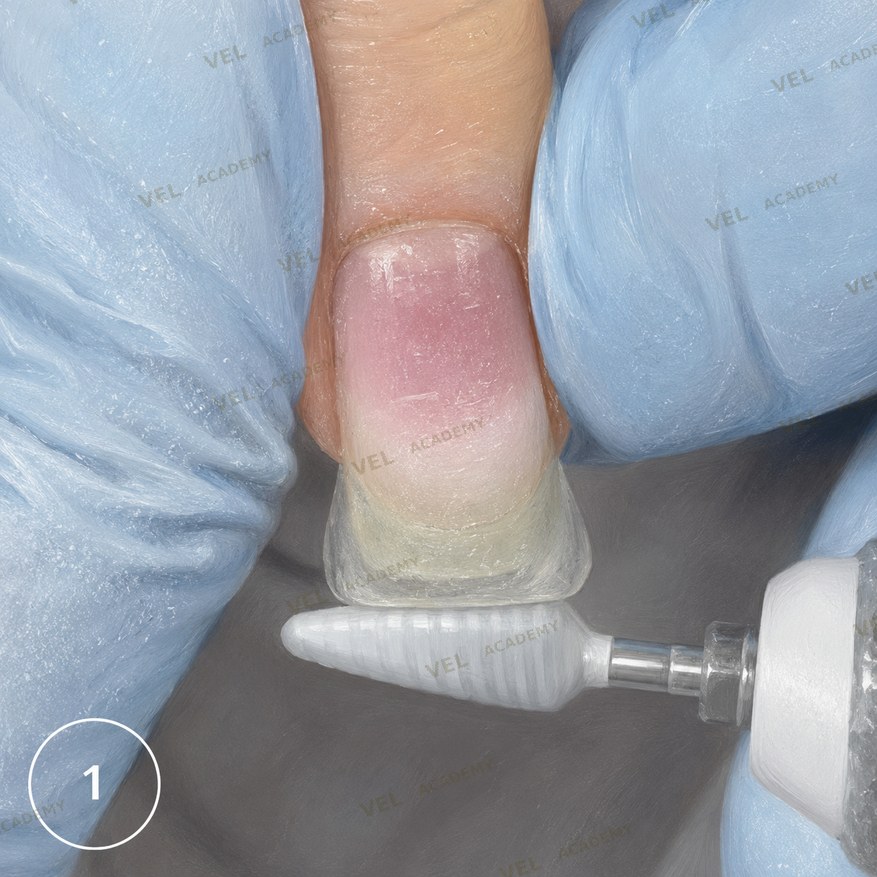
Post-restoration filing step 1 removing length with e-file at 20000 RPM

Step 1 — Remove length, e-file

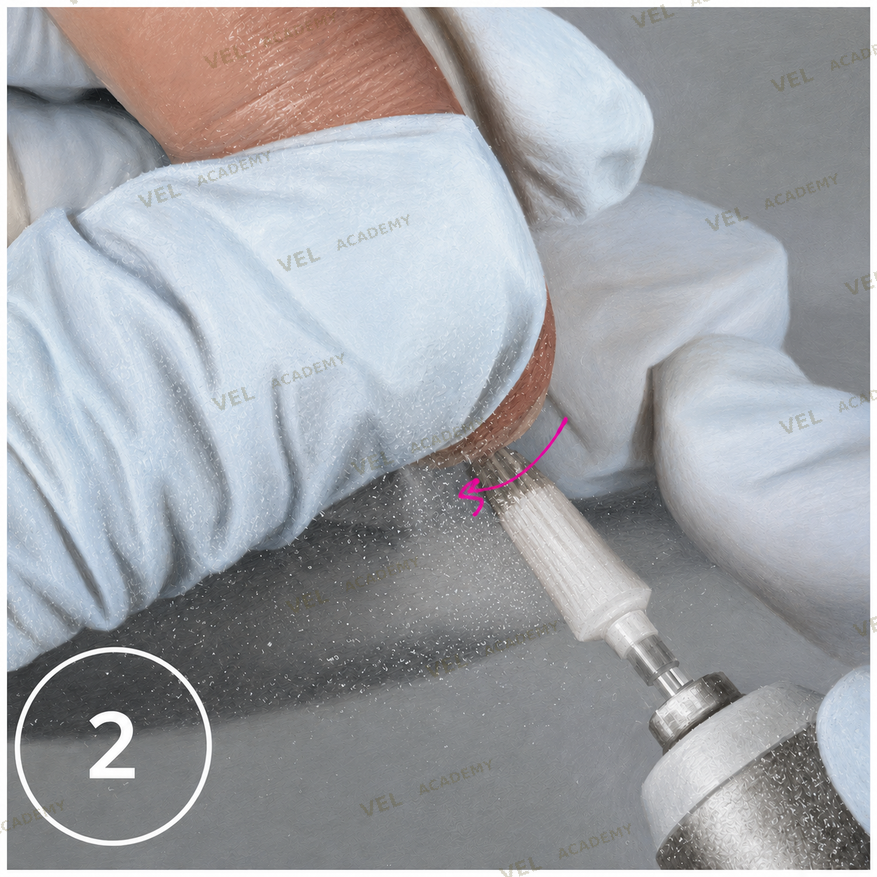
Post-restoration filing step 2 flip hand technique free edge filing

Step 2 — Flip hand, free edge

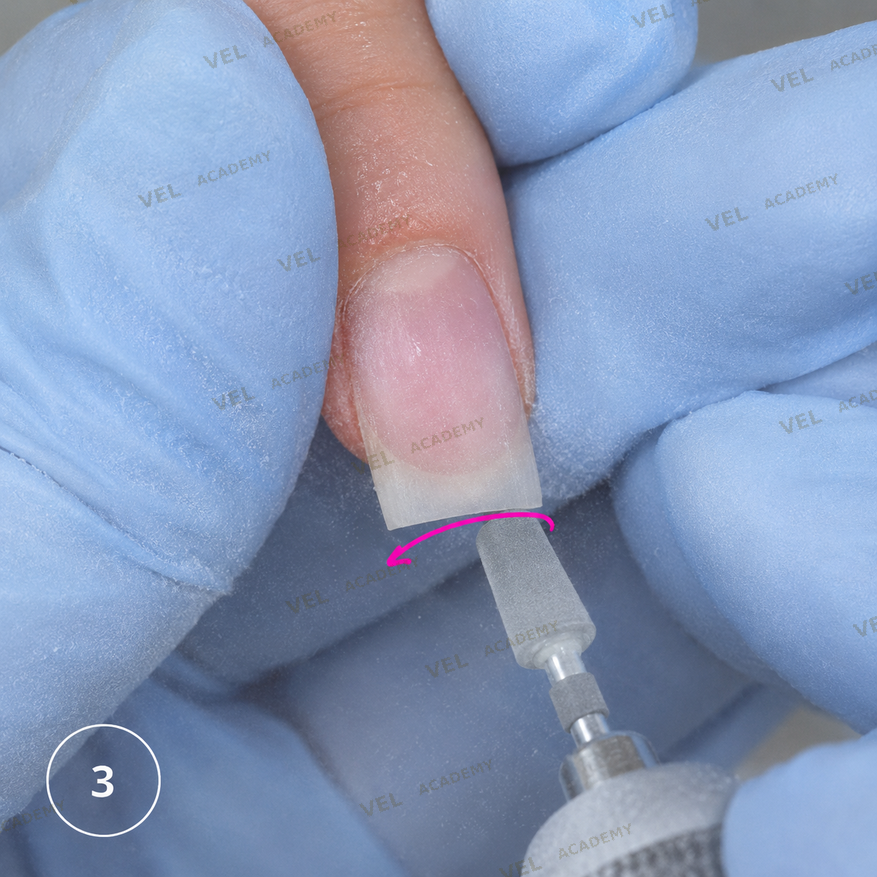
Post-restoration filing step 3 arch correction without flipping hand

Step 3 — Arch correction

Step 1 — Remove Excess Length with E-File at 20,000 RPM FWD

The first step removes excess PolyGel length at 20,000 RPM FWD. This is an e-file step — not a hand file step. The material volume is too high for efficient hand file work at this stage. The e-file removes the bulk while preserving the lateral parallel correction from the restoration step.

Step 2 — Flip the Hand and File the Free Edge

Flip the hand and file the free edge from the flipped position to lift it — without going too deep into the restoration material. The flipped position gives a different angle of view and control over the free edge thickness. This step is specific to post-restoration filing — it does not appear in standard square shape filing.

Step 3 — Arch Correction Without Flipping

Return to the standard position and even out the arch without flipping the hand. This step corrects any surface irregularities created during PolyGel application, preparing the nail for shape filing. Viewing from the side is essential at this stage.


Free Nail Diagnosis Map – Stop Lifting,
Breakage & Shape Problems in 60 Seconds.
GET IT NOW.
This Diagnosis map is a practical troubleshooting tool for nail techs. It helps you identify the most likely cause of common failures and apply a First Fix (the smallest change with the biggest impact).

Identifying Nail Deformation: What to Assess Before Choosing a Method

Correct method selection requires correct deformation identification — and deformation is easiest to assess before the coating is removed, because the existing coating sometimes reveals the nail geometry more clearly than the bare plate.

In VEL Academy technique, three characteristics are assessed before any correction method is chosen:

  • Free edge direction — look at the nail from the side. Is the free edge pointing straight forward, curving downward (hook), or deviating sideways? The degree of deviation determines whether Sides, Gel, or PolyGel Architecture is appropriate.
  • Lateral parallel alignment — look at the nail from the front. Are the two lateral walls parallel to each other, or does one angle inward or outward? Asymmetry visible from the front indicates lateral parallel deformation that Sides or PolyGel Architecture needs to address.
  • Nail plate thickness — assess after removal. Does the plate feel normal under light pressure, or does it flex unusually? A papery or extremely thin plate requires PolyGel Architecture with specific material thickness considerations rather than standard correction.

The assessment before removal: in VEL Academy technique, the deformation assessment happens before the coating is removed — not after. The existing coating shape gives information about the nail geometry underneath. After removal, the bare plate may look different from what the coating suggested, and the method choice is confirmed at that point. But the initial assessment gives a working hypothesis before any tools are applied.

Taking on clients others won't: the combination of correct deformation identification and the right correction method is what allows a trained nail technician to accept clients with hooked, twisted, or severely thinned nails that other technicians decline. In English-speaking markets, where Russian manicure restoration technique is genuinely uncommon, this capability is a meaningful competitive differentiator — and VEL Academy teaches it in English specifically because almost no professional training in this technique exists outside of Russian-language sources.

Frequently Asked Questions

How is square filing after PolyGel restoration different from standard square filing?

Post-restoration filing begins with an e-file at 20,000 RPM — not a hand file — because the PolyGel material volume is too thick for efficient hand filing as the first step. It also includes a flip-the-hand free edge step and arch correction pass that standard square filing does not.

Why does post-restoration filing start with an e-file?

PolyGel material is significantly thicker than standard coating. The e-file at 20,000 RPM removes the bulk efficiently before the hand file takes over for shape refinement — using a hand file first would require excessive pressure and produce uneven results.

How do I identify nail plate deformation before an appointment?

VEL Academy recommends assessing three things: free edge direction (straight, hooked, or curved sideways), lateral parallel alignment from the front (symmetrical or twisted), and nail plate thickness after removal (normal, thin, or severely thinned). These together determine the correct correction method.

What does the tactile and visual check in step 5 reveal?

The tactile check reveals remaining high spots or ridges not yet visible. The visual side check confirms arch profile and surface evenness. Both together confirm whether additional e-file work is needed before hand file shape filing begins.

Can all nail deformations be corrected with PolyGel Architecture?

PolyGel Architecture addresses the most common structural deformations — hooked nails, twisted lateral parallels, thinned plates. Presentations with active infection or onycholysis require medical attention before any correction material is applied.

Professional Course

Master Nail Restoration Filing and Deformation Assessment — In English

VEL Academy's Problem Nails Masterclass teaches the complete post-restoration filing sequence, deformation identification, and all three correction methods — with full video demonstration on real clients.

View Problem Nails Masterclass — $131.99