Silicon-Carbide Bit Polishing After E-File Cuticle Work: Who Needs It and How It's Done
VEL Academy methodology: The silicon-carbide polishing step described in this article is part of VEL Academy's cuticle work finishing sequence. It is a conditional addition to the standard flame bit routine — recommended for specific client presentations. Other schools may handle dry skin finishing differently.
The silicon-carbide bit is the last tool in the cuticle work sequence — and it is not used with every client. In VEL Academy Russian manicure technique, it is a conditional finishing step for clients whose skin requires more smoothing than the flame bit provides. Knowing which clients need it, what RPM to use, and exactly where the bit moves is what makes this step precise rather than approximate.
Where This Step Fits in the Cuticle Work Sequence
The standard cuticle work sequence in VEL Academy Russian manicure follows this order: orange stick and talc preparation → flame bit FWD sequence (left side) → flame bit REW sequence (right side) → cuticle scissors → REW finishing pass after scissors → silicon-carbide polishing if needed.
Silicon-carbide polishing is always the last step — after everything else has been completed. It is not a substitute for the flame bit sequence, and it is not performed before scissors. It addresses what remains after the standard sequence has done its work: residual dryness or roughness on the skin surface around the nail that the flame bit, by the nature of its design, could not fully smooth.
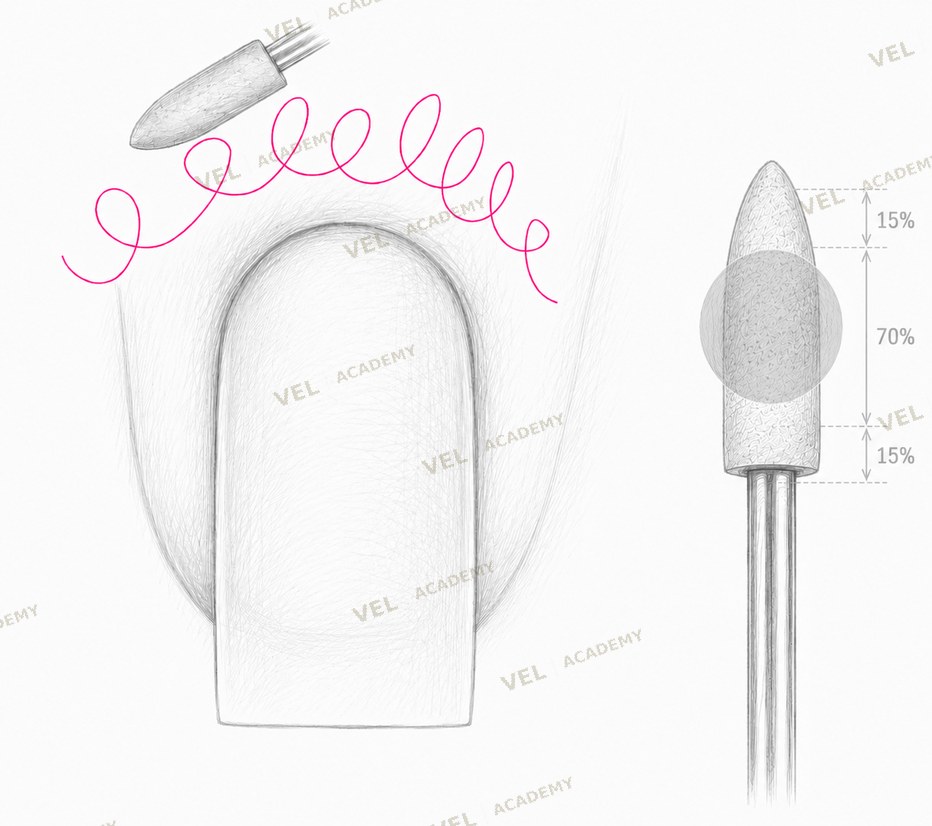
Silicon-carbide bit polishing at 5,000 RPM FWD — the finishing step for clients with dry hands or dermatitis
Which Clients Need Silicon-Carbide Polishing
Silicon-carbide polishing is indicated for a specific subset of clients — not the majority. In VEL Academy technique, the two presentations that call for this step are:
- Clients with very dry hands — where the skin around the nail has a rough, textured surface that persists after the flame bit sequence. The flame bit addresses dead skin in defined zones (pterygium, lateral pocket, ridges), but it does not smooth the general skin surface around the nail. For clients with chronic dryness, this surface texture is visible and tactile after the flame bit work is complete.
- Clients with dermatitis — where the skin condition creates persistent roughness, scaling, or uneven texture around the nail zone. Dermatitis clients often have more pronounced dryness between appointments, and the silicon-carbide bit provides controlled smoothing that would be difficult to achieve manually.
For clients with normal skin who do not have persistent dryness after the flame bit sequence, this step is skipped. Adding it as a routine step for all clients adds time without improving the result on skin that does not need it.