FWD and REW in Russian Manicure Cuticle Work: Which Rotation Covers Which Zone and Why
VEL Academy methodology: The FWD/REW sequence described in this article — FWD for the left side, REW for the right — is the approach VEL Academy recommends for efficient, repeatable cuticle work. Other Russian manicure schools and practitioners may use different rotation schemes or combine directions differently based on their training. The sequence here is a methodological recommendation for speed and safety, not a universal rule of the technique.
The flame bit cuticle sequence in Russian manicure is not a freehand technique — it is a defined system of movements divided between two rotation directions. FWD (forward) handles the left side of the nail. REW (reverse) handles the right side. Each direction is assigned to specific zones because of how the cutting edges of the bit engage with tissue depending on rotation. Understanding the logic makes the sequence reproducible, fast, and safe across every client.
Why Rotation Direction Matters
The flame bit has cutting edges — microscopic diamond particles arranged on its surface. These particles cut most efficiently when the bit rotates in the direction that engages their leading edge against the tissue. In FWD rotation, the bit cuts most effectively when moving across tissue from right to left — which aligns with the left-side zones of the nail. In REW rotation, the engagement reverses — making it more effective for right-to-left approach from the opposite angle.
In VEL Academy technique, this is treated as a mechanical property of how the bit interacts with tissue — and informs why the sequence is structured as it is. Using FWD for zones that should be approached in REW does not produce incorrect results, but it requires more passes to achieve the same tissue removal because the cutting efficiency is lower. In a timed service, those extra passes are time you do not have.
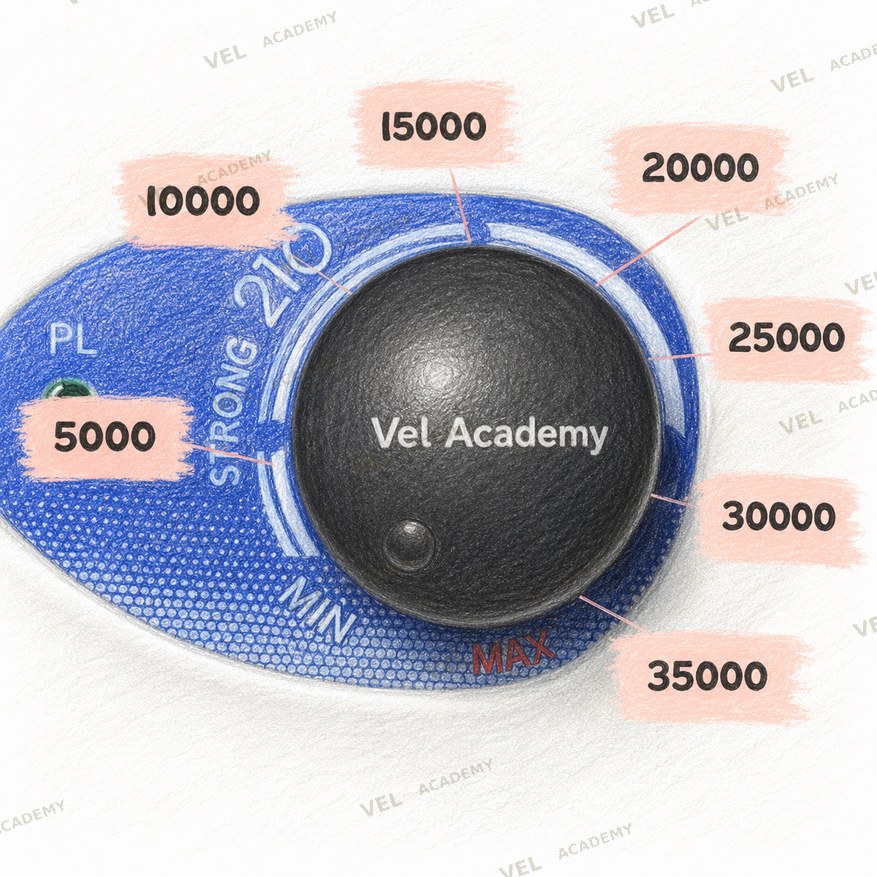
Both FWD and REW sequences run at 10,000 RPM — the speed that provides control without heat buildup in the cuticle zone
The FWD Sequence: Left Side of the Nail (4 Steps)
FWD rotation is used for the left side of the nail, starting from the right sinus. The sequence covers four zones in order, and the rule is absolute: complete one zone fully before moving to the next. Do not return to previous movements.

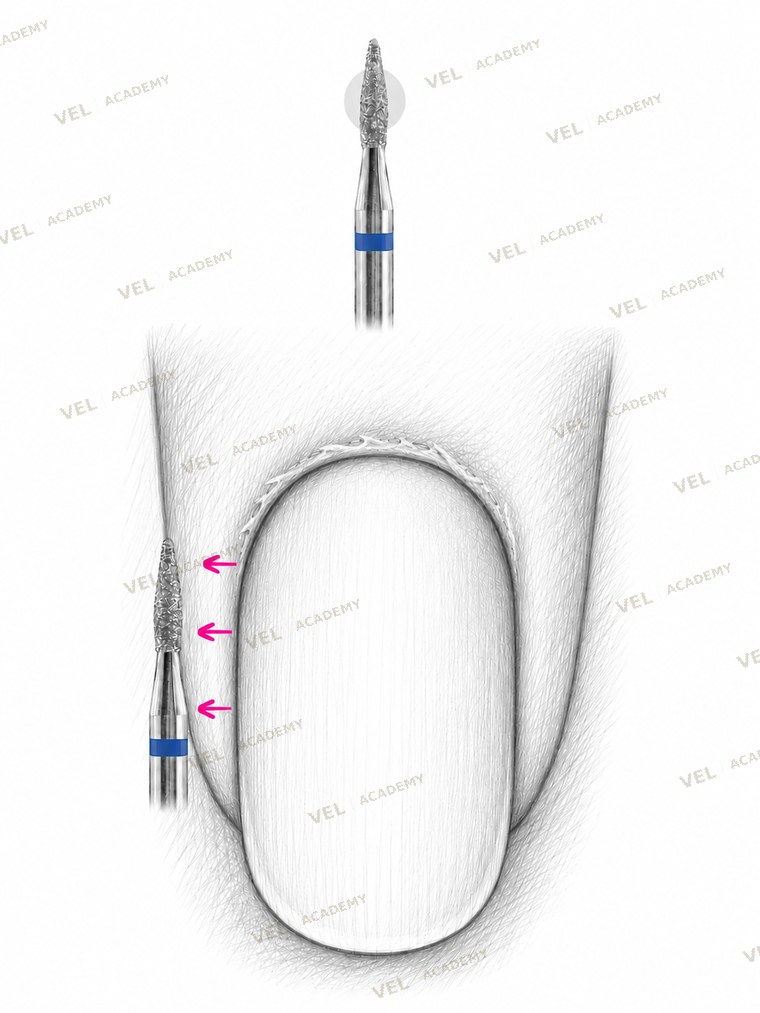
Step 1 — Pterygium removal
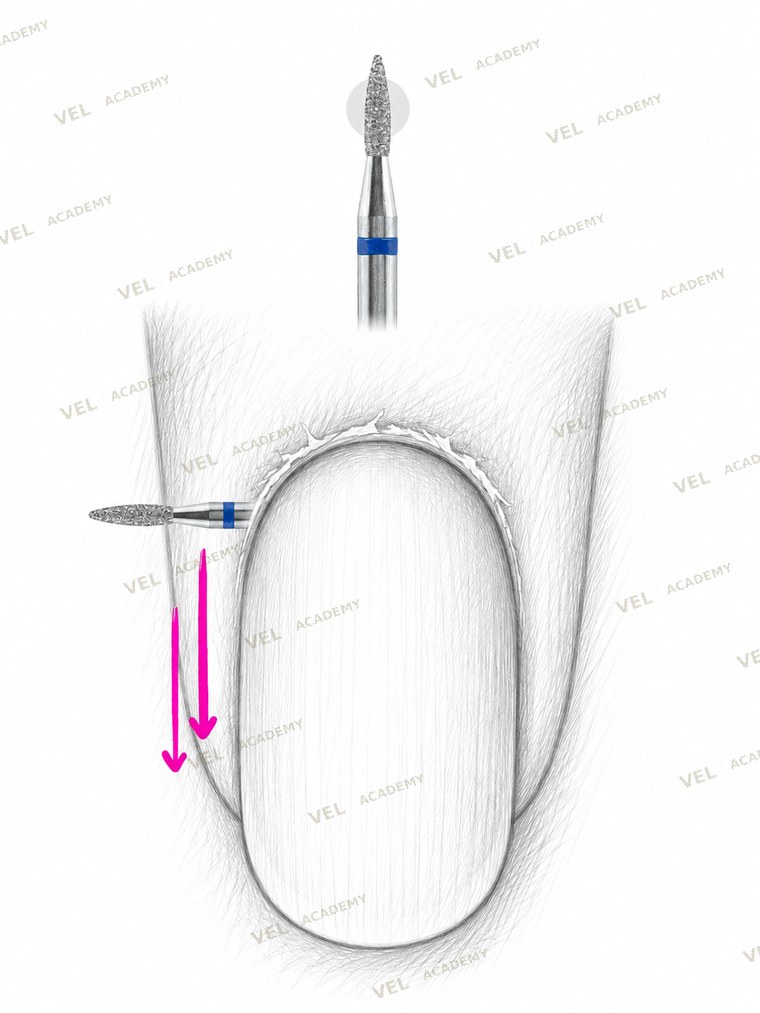
Step 2 — Lateral groove
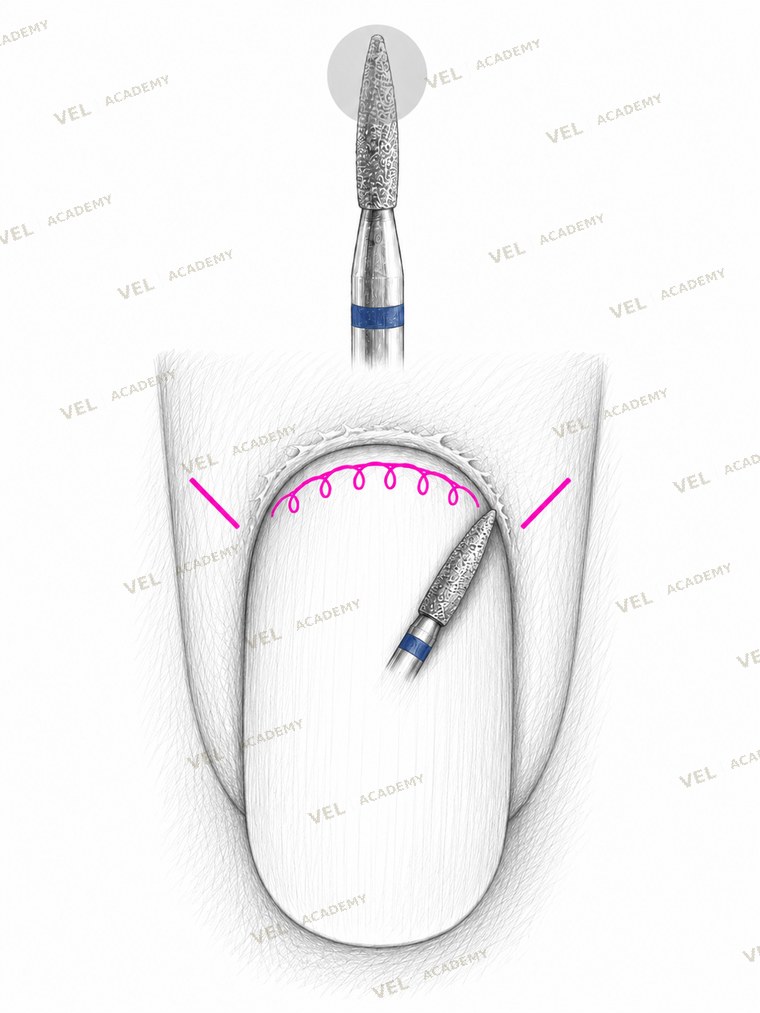
Step 3 — Ridge left to right
Step 4 — Ridge top to bottom
FWD Step 1 — Pterygium Zone
Remove pterygium using the cheek of the bit at a diagonal angle, working from the right sinus to the left with short circular strokes along the nail plate. If needed, work the lateral nail wall with circular motions. The cheek — not the tip — is the correct contact point. The tip concentrates pressure; the cheek distributes it.
FWD Step 2 — Lateral Groove
Open the lateral groove: position the tip of the bit diagonally deep from the sinus and draw it to the end of the free edge in one long stroke. This stroke opens the pocket between the nail and the lateral skin fold. It is a single continuous movement — not multiple short strokes.
FWD Step 3 — Ridge Dryness (Left to Right)
Remove dryness from the nail ridge using left-to-right strokes with the belly of the bit, cutting from above. This movement addresses the upper surface of the ridge — the zone that the lateral groove stroke cannot reach because the angle is different.
FWD Step 4 — Ridge Dryness (Top to Bottom)
Remove remaining dryness from the ridge using top-to-bottom strokes. This step addresses the ridge surface that the left-to-right strokes did not fully cover. After step 4, the left side of the nail is complete — pterygium cleared, lateral groove opened, ridge addressed from both directions.
VEL Academy rule: in this technique, complete one zone fully before moving to the next. Do not return to previous movements. This recommendation exists for two reasons: it maintains the efficiency of the sequence (returning to zones costs time), and it maintains the safety of the technique (returning to a zone where pressure and angle have already been established increases the risk of catching skin).
The REW Sequence: Right Side of the Nail (4 Steps)
REW rotation is used for the right side of the nail, starting from the left sinus. The sequence mirrors the FWD approach in logic but differs in entry points and stroke directions. Each REW movement is repeated approximately 3 times — the exact number depends on the complexity of the client's hands.
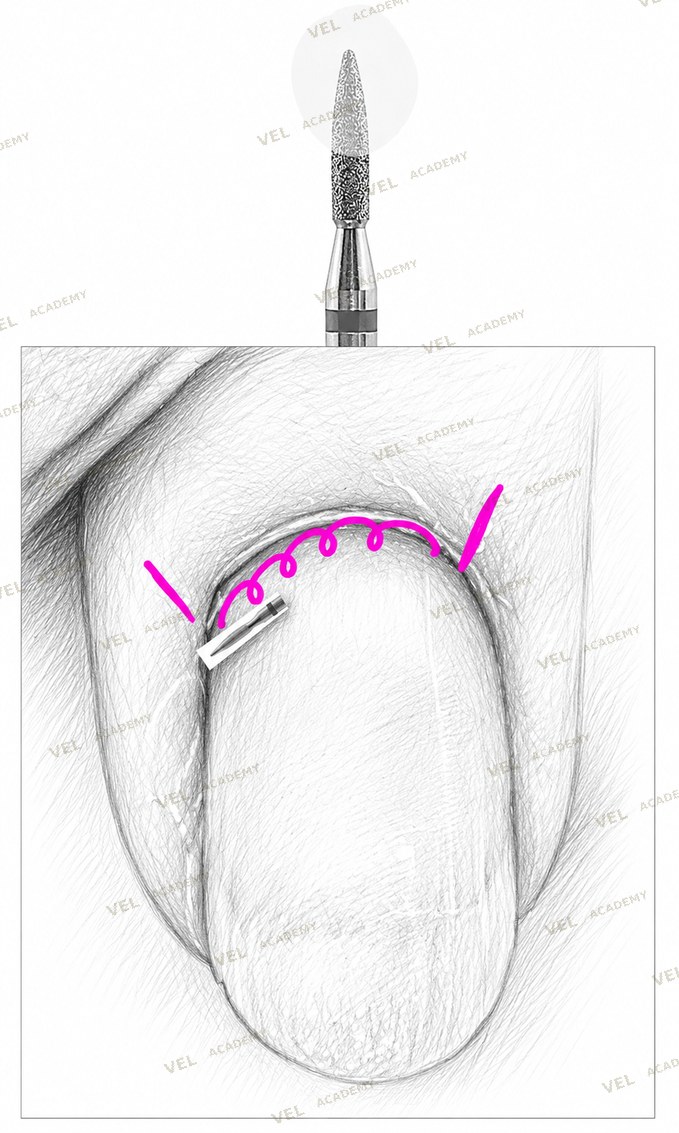
Step 1 — Open pocket
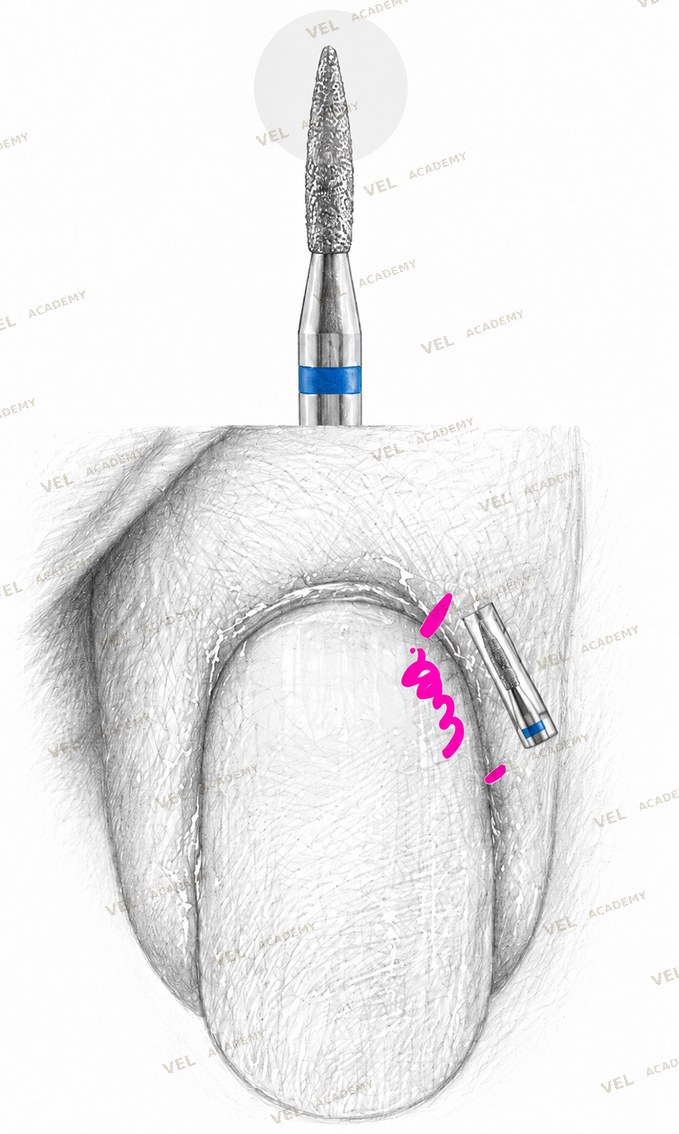
Step 2 — Right sinus
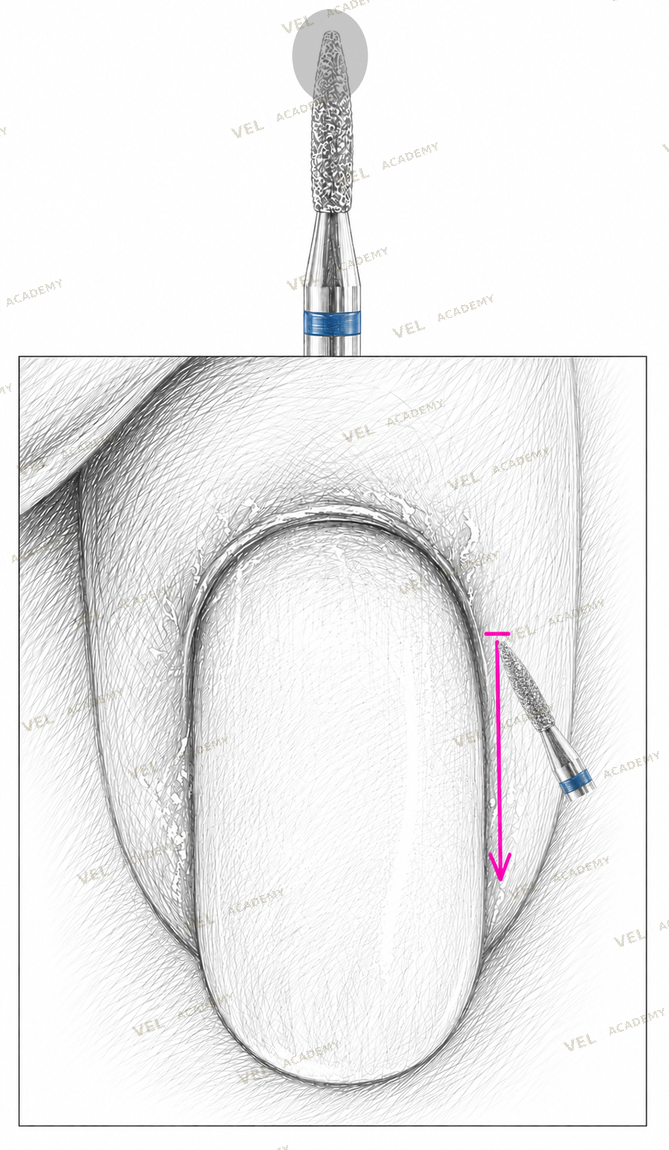
Step 3 — Right lateral groove
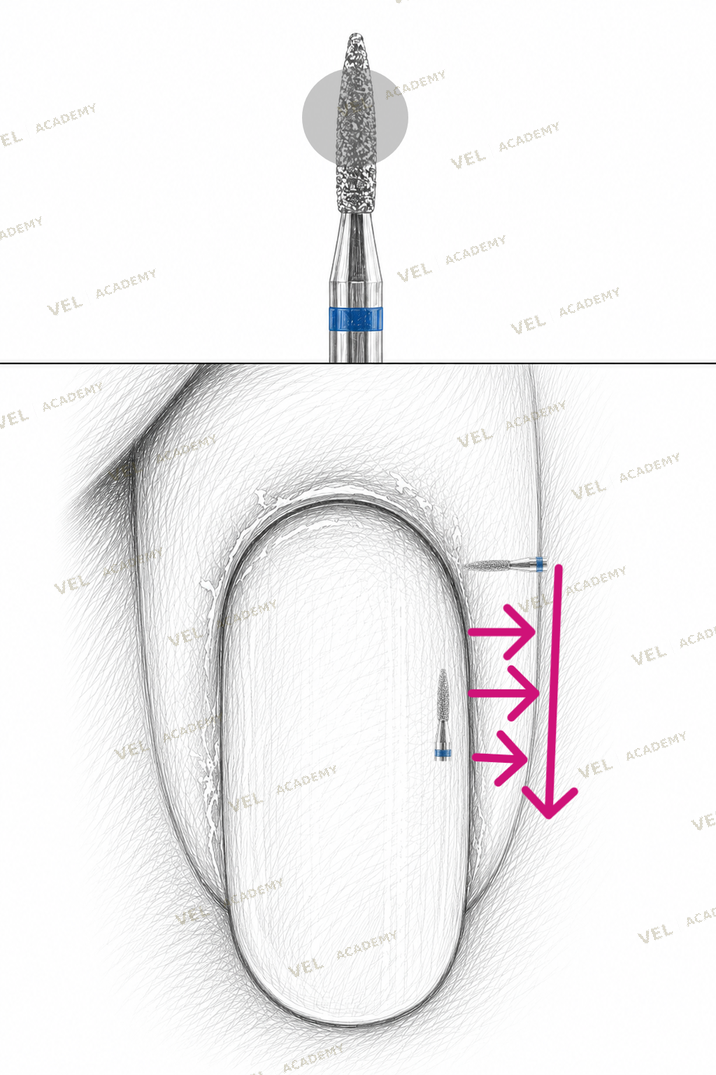
Step 4 — Right ridge
REW Step 1 — Open the Pocket
Position the tip at an angle into the left sinus with the cheek pressed upward into the skin. Draw the bit from the left sinus to the right sinus without entering it. This stroke opens the cuticle pocket across the full width of the nail in one movement — the starting point for everything that follows on the right side.
REW Step 2 — Right Sinus Correction
Smooth the right sinus area if needed — cheek pressed diagonally into the skin, removing any pterygium near the right sinus that the FWD sequence did not reach. This is a corrective step, performed when the assessment during step 1 identifies residual pterygium at the right sinus.
REW Step 3 — Right Lateral Groove
Open the right lateral groove: tip of the bit goes diagonally deep from the right sinus to the end of the free edge in one long stroke. This mirrors FWD step 2 but covers the right side. The stroke direction and entry angle differ because the approach is from the opposite sinus.
REW Step 4 — Right Ridge Dryness
Remove dryness from the right nail ridge using the belly of the bit, cutting from above. Each movement is repeated approximately 3 times. The exact count depends on the amount of dryness present — more dryness requires more repetitions, not more pressure.