Three Steps: Entry, Cut, and Finish
The cutting sequence in VEL Academy technique has three defined steps. Each step has a specific purpose, and the sequence only produces a clean result when all three are completed in order.
Step 1 — Entry at 45° in sinus
Step 2 — Rotate to 90°, work tips
Step 3 — Tips upward, no burrs
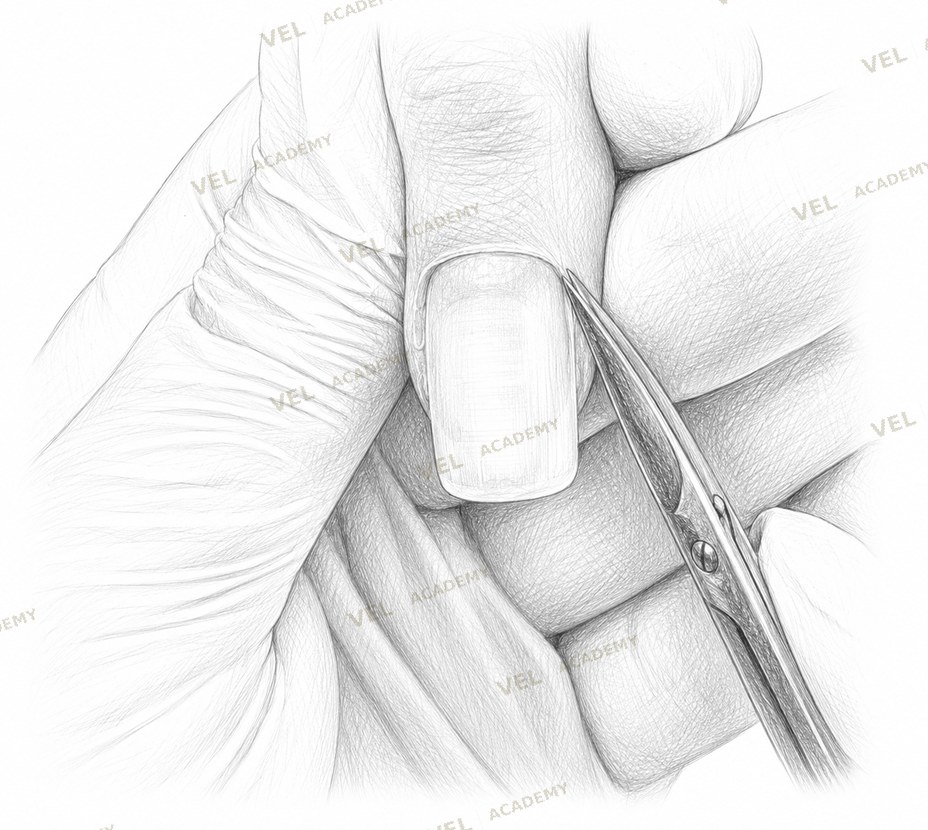
Step 1 — Entry at 45° in the Right Sinus
Position the scissors at 45° in the right sinus. This is the entry point for the cut — not the center of the cuticle line, and not the left sinus. Starting in the sinus with a 45° angle allows the blades to enter cleanly without catching the skin at the transition between the lateral wall and the cuticle line. The scissors must be parallel to the cuticle at the entry point.
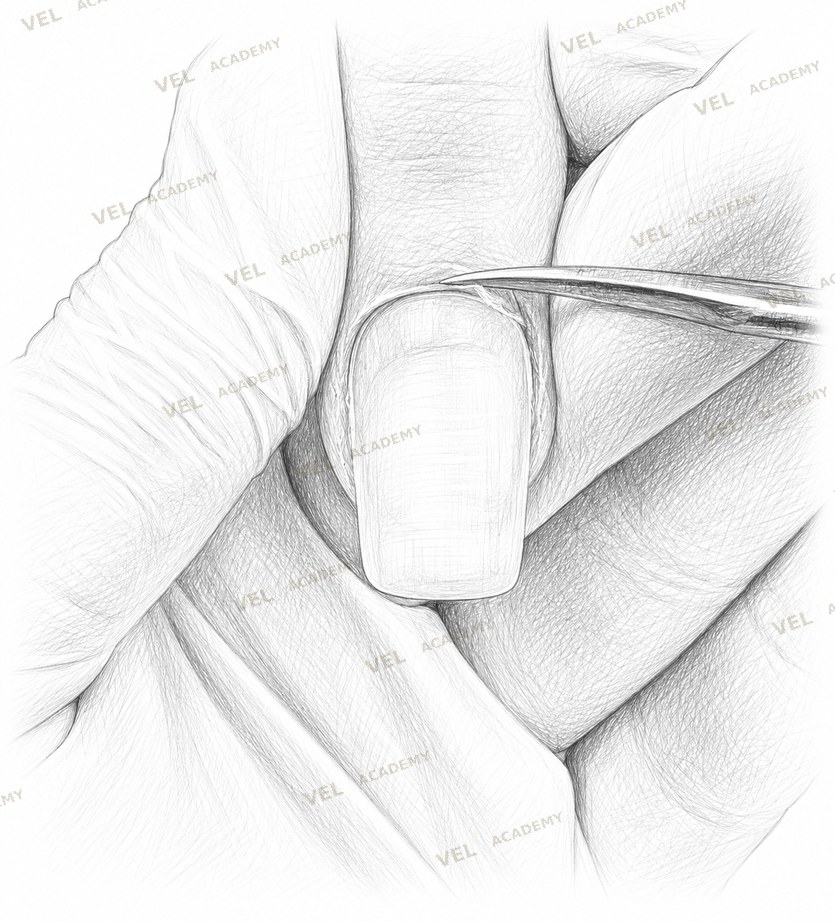
Step 2 — Rotate to 90°, Step 1mm Forward, Work with Tips
After entry, rotate the scissors to 90° and step forward approximately 1mm. Work along the cuticle line using the tips of the blades — not the full blade length. Short, controlled cuts with the tips rather than full blade cuts are what produce a smooth, even edge rather than a jagged one. Each tip movement steps forward 1mm along the cuticle curve. The scissors remain parallel to the cuticle throughout this step.
Step 3 — Tips Upward to Finish Without Burrs
Before completing the final cut, point the scissor tips upward and finish the cut with the blade continuing in this upward position. This upward finish is the specific movement that prevents burrs. When scissors finish a stroke with the tips level or angled downward, a small tag of skin remains at the endpoint — the burr. Pointing the tips upward before the final cut closes the blade away from that tag rather than into it.
The burr problem explained: Burrs are not random — they are caused by a specific moment in the scissors stroke where the blade closes in a direction that leaves a small attached tag of skin. In VEL Academy technique, the upward tip finish in step 3 is the direct solution. It is a half-second movement that eliminates the most common visible imperfection in cuticle scissors work.
What Comes After Scissors: The REW Finishing Pass
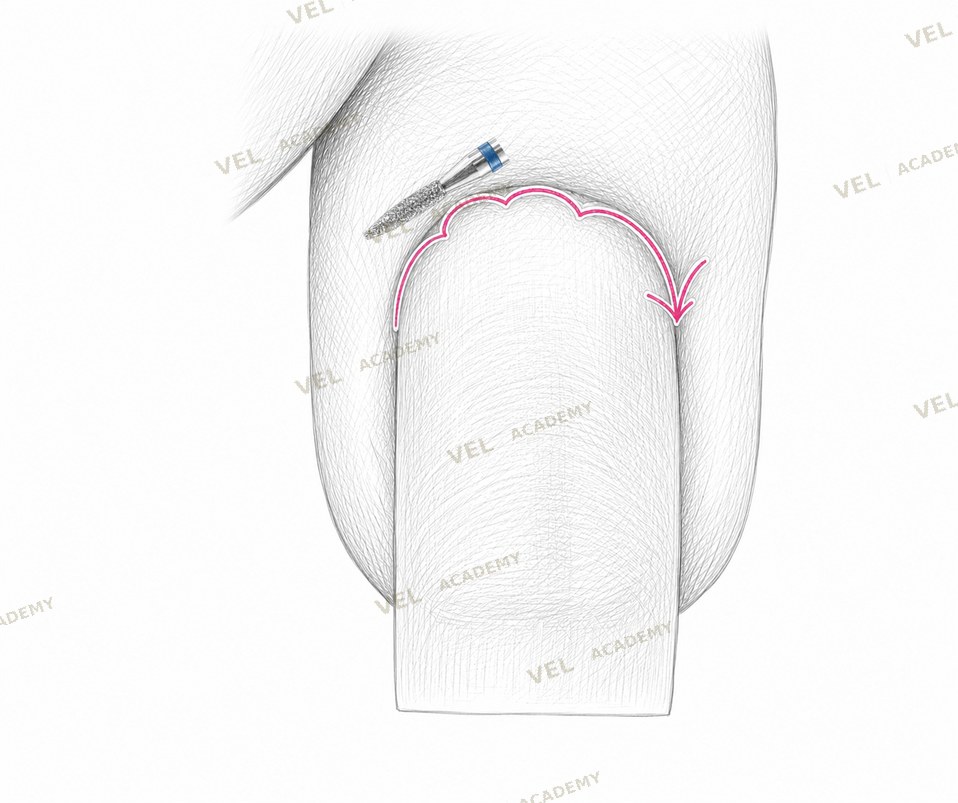
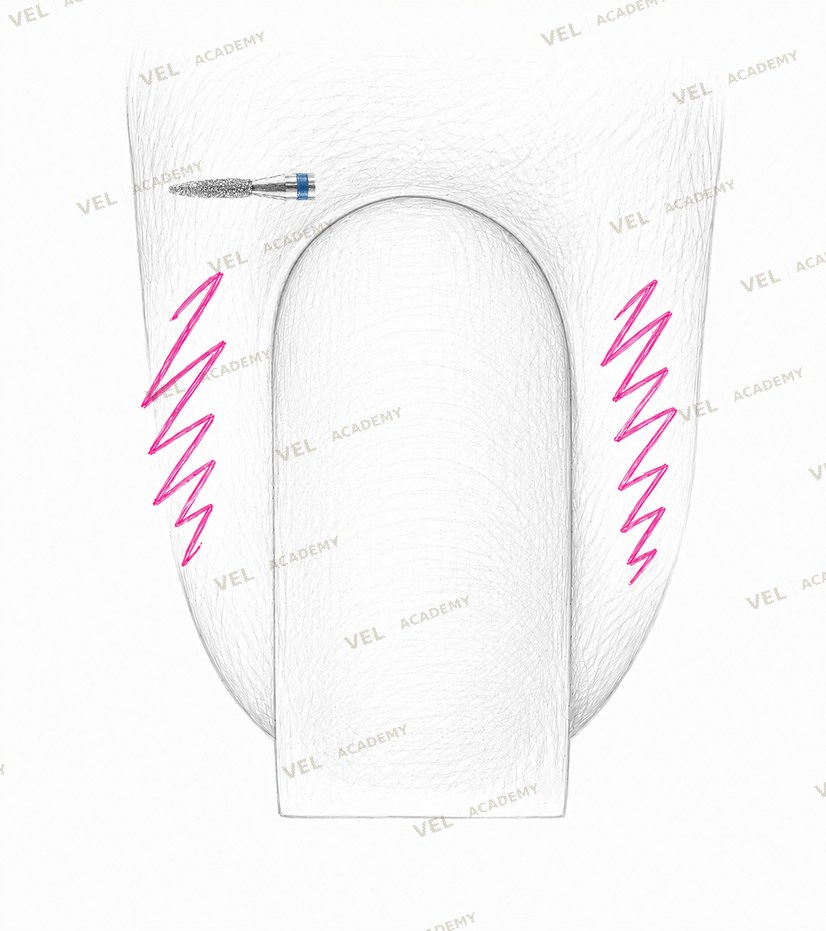
After scissors, the flame bit is used one more time — a REW finishing pass at 10,000 RPM that covers the cuticle zone from left sinus to right. This pass addresses any remaining skin that the scissors could not reach: tissue in the very corners of the sinus zone, small irregularities along the cut edge, and any ridge dryness that was disturbed by the scissors work.
REW finishing pass after scissors — covers what scissors could not reach
REW finishing — ridge coverage if dryness remains
Completed cuticle work sequence: flame bit FWD → REW → scissors → REW finishing pass
The REW finishing pass is not a correction for scissors errors — it is a designed part of the sequence that the scissors stage assumes will follow. The scissors cut the cuticle line; the finishing pass cleans up the surrounding zone. Together they produce the result that neither tool could achieve alone.
For licensed nail technicians: The scissors stage in Russian manicure cuts the cuticle line — the thin strip of dead skin along the growth zone. It does not cut into living tissue. The flame bit work before scissors has already separated and loosened the dead cuticle; the scissors complete the cut on what the bit has defined. This is the non-invasive principle applied to scissors work: the tool operates on tissue that has already been identified and prepared, not on living skin encountered without preparation.
How Scissors Technique Affects Service Speed
The two-grip, three-step scissors technique is faster than single-grip cutting for a counterintuitive reason: it produces a clean result the first time, without the correction passes that an imprecise cut requires. A cut that leaves burrs needs a correction pass — either with scissors again or with the flame bit. A cut made with the correct grip transitions and the upward tip finish requires no correction.
The net time saving is not in the scissors stroke itself — it is in the elimination of correction. This is consistent with the broader principle of VEL Academy Russian manicure technique: precision at each step eliminates correction work downstream, and the cumulative effect of eliminating correction across every stage of the service is where the up to 30% efficiency improvement comes from.
Frequently Asked Questions
How do you hold cuticle scissors in Russian manicure?
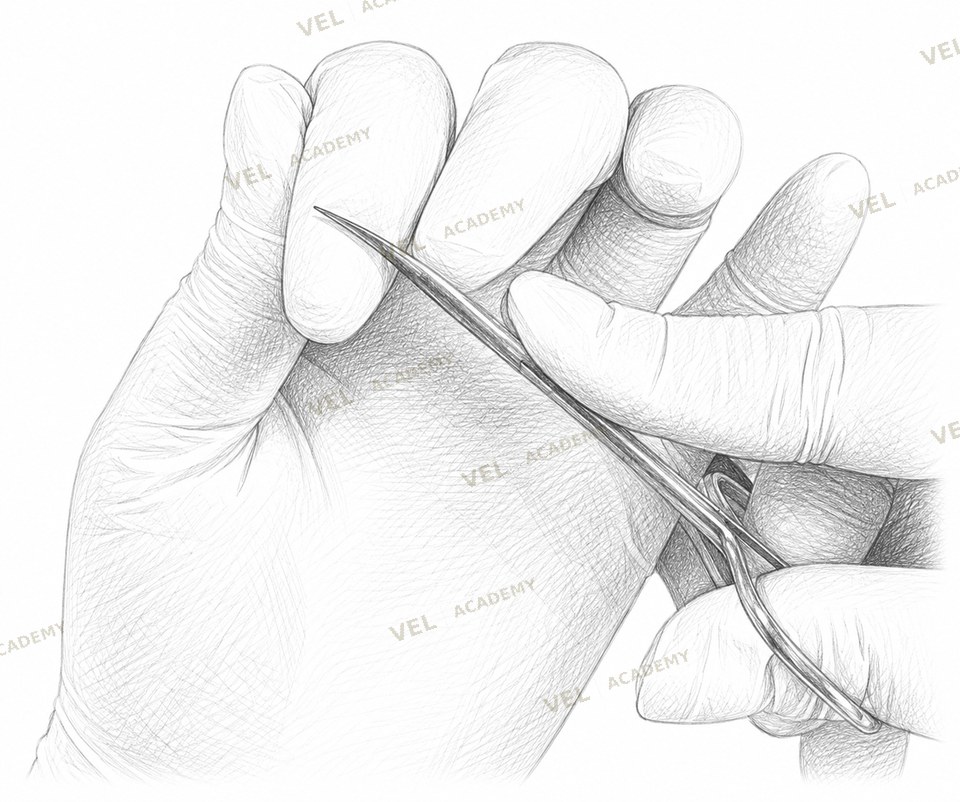
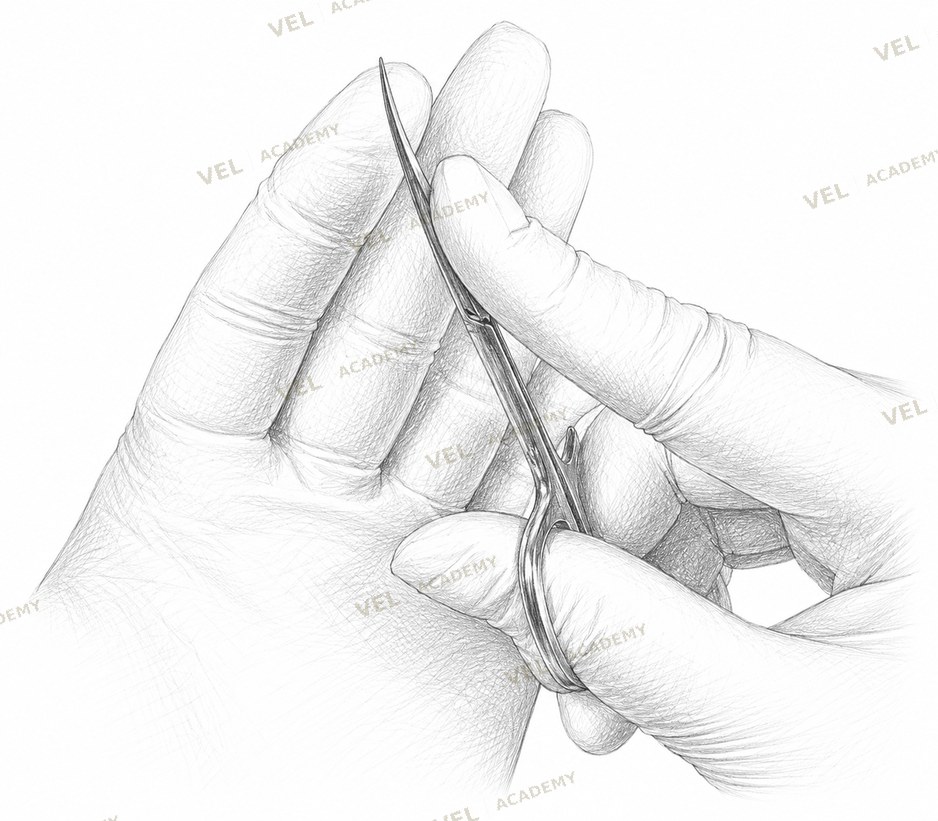
VEL Academy teaches two grip positions. Grip 1: thumb in the right loop, middle or ring finger in the left loop, index finger on the screw — gives a 90° cutting angle. Grip 2: thumb in the left loop, middle finger in the right loop, index finger on the screw — gives a 45° angle for the sinus and lateral wall. Switching between both grips mid-cut is what produces a clean, burr-free result.
What are the three steps of cuticle cutting with scissors in Russian manicure?
In VEL Academy technique: Step 1 — position scissors at 45° in the right sinus. Step 2 — rotate to 90°, step 1mm forward, work along the cuticle line with the tips. Step 3 — point tips upward to finish the cut and prevent burrs.
Why do burrs form after cuticle cutting and how do you prevent them?
Burrs form when scissors finish the stroke with tips pointing downward or sideways, leaving a small tag of skin at the end point. In VEL Academy technique, pointing the tips upward before completing the final cut closes the blade away from that tag — this is the direct prevention for burrs.
Do scissors replace the flame bit in Russian manicure or work alongside it?
In VEL Academy technique, scissors and the flame bit work together in sequence. The flame bit addresses pterygium and dry skin first. Scissors then cut the cuticle line. The flame bit is used again after scissors in a REW finishing pass to address any remaining skin the scissors could not reach.
Why must scissors be parallel to the cuticle at all times during cutting?
Scissors that drift off parallel create an angled cut rather than one following the natural curve of the cuticle line — producing an uneven edge and small uncut sections between strokes. Maintaining parallel alignment throughout the stroke is what produces the clean, even cuticle line that Russian manicure is known for.
Professional Course
Master Russian Manicure Scissors and E-File Technique — In English
VEL Academy teaches the complete cuticle work system — flame bit sequences, scissors technique, and finishing — for licensed nail technicians who want consistent, professional results with every client.
View Complete Bundle — $311.99