Tool and Workstation Disinfection for Manicure and Pedicure Technicians
Sanitation requirements are often treated as paperwork for inspectors — something you follow because "that's the rule." In reality, it's the one thing that actually protects both the client and the tech's license. One broken protocol, and there's a fine waiting — or worse, a client walks away with a fungal or bacterial infection. Here's how to properly handle tools and the workstation for manicure and pedicure services, including e-file work.
One note up front: the specific numbers — contact time in solution, which disinfectants are approved, whether an autoclave is mandatory — vary from state to state in the US, and from country to country. What follows are widely accepted industry principles; you'll still need to check your own regulator's requirements before you start working.

Three Levels You Can't Mix Up
Cleaning, disinfecting, and sterilizing aren't synonyms or interchangeable steps — they're a strict sequence.
First comes mechanical cleaning: soap, water, a brush, removing everything visible. Skip this step and you devalue everything after it, because organic matter on a tool — skin, blood, dust — reduces the effectiveness of any solution, no matter how strong.
Next is disinfecting: fully immersing the already-cleaned tool in an EPA-registered, hospital-grade disinfectant, for exactly the time listed by the manufacturer on the label — usually 10 minutes or more. Wiping with alcohol or a wipe is not the same thing, whatever gets said in beginner chat groups.

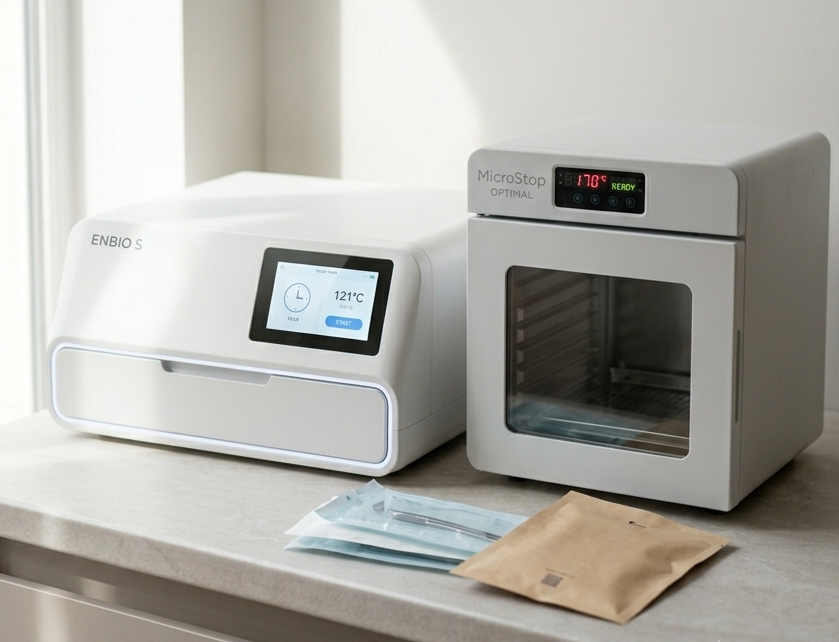
And only after that, when needed, comes sterilizing: the complete destruction of all microorganisms, including spores, using an autoclave or a dry heat sterilizer. This step isn't written into every regulator's rules as mandatory for every single tool, but it's the gold standard for anything that contacts blood or broken skin. There's an important nuance that somehow rarely gets said outright: while your client volume is still small, full immersion in a disinfectant is genuinely enough — it's a recognized working minimum, not a compromise with your conscience. But once your book gets steady and tightly scheduled, an autoclave or dry heat sterilizer shifts from a nice-to-have to a practical necessity: the more clients pass through a given tool, the higher the cost of a mistake, and an autoclave destroys microorganisms including spores, while a solution soak — already a recognized minimum — simply isn't the same level of processing.
There are additional reasons to make this purchase earlier than your booking volume strictly requires. First, client trust: more and more people check what proper salon hygiene should look like before they book, and an autoclave is one of the clear signals they're looking for — while UV boxes marketed as "sterilizers," or disinfection without sterilization, tend to show up on those same checklists as a red flag. Second, inspection risk: inspectors specifically look at sterilization protocol, and in a number of states (California, New York, Florida, Texas, among others) an autoclave is no longer just a recommendation but a direct regulatory requirement — meaning its absence there isn't just bad form, it's a concrete risk of a fine.
Metal That Gets Used Again and Again
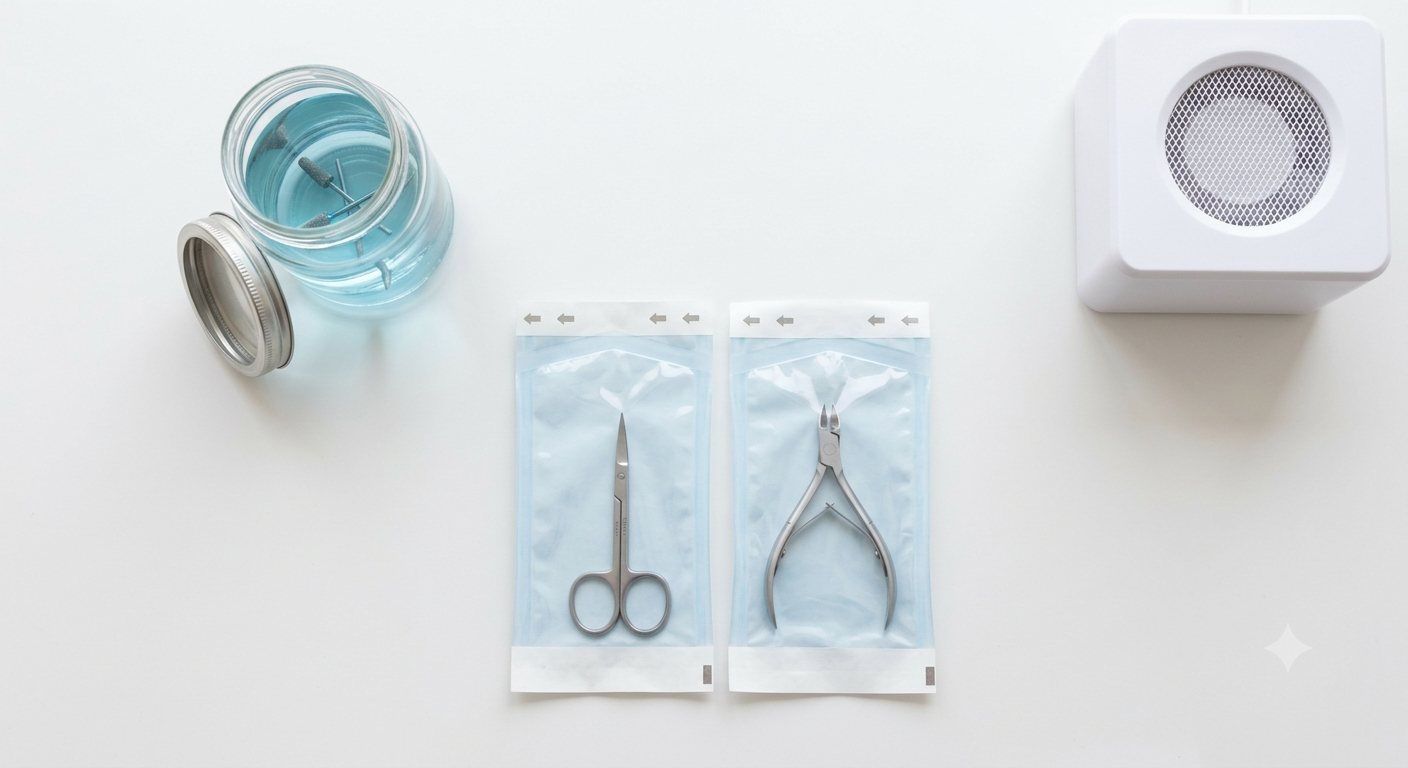
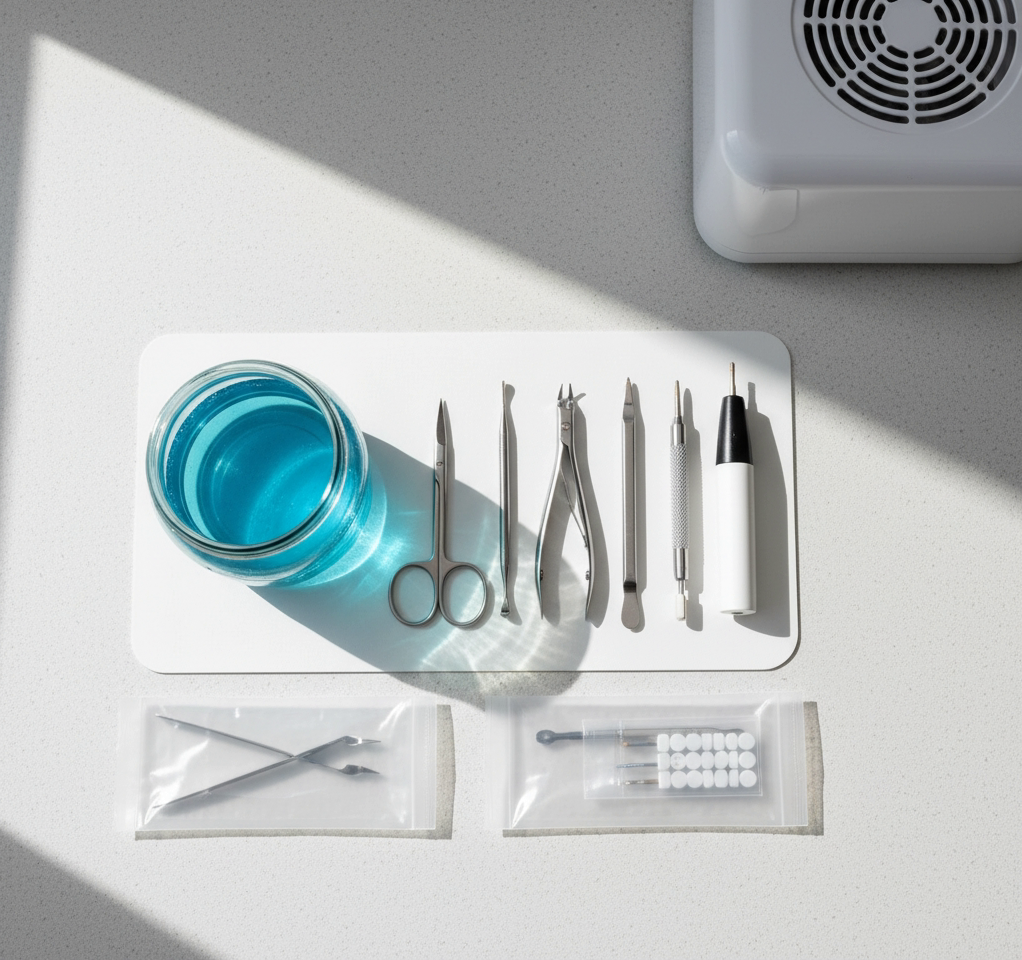
Cuticle scissors, nippers, the metal pusher, e-file bits — all of it gets washed of visible debris with soap and a brush, then dried completely (moisture dilutes the solution's concentration — a small detail that's easy to miss), and only then fully immersed in solution for the required time. The solution gets changed daily: used solution loses strength faster than people expect. Sterilize as a final step when possible, especially for anything that can break skin. And sterilized tools need to be stored separately from unprocessed ones, in sealed pouches — mix the two sets even once, and the whole protocol loses its point.
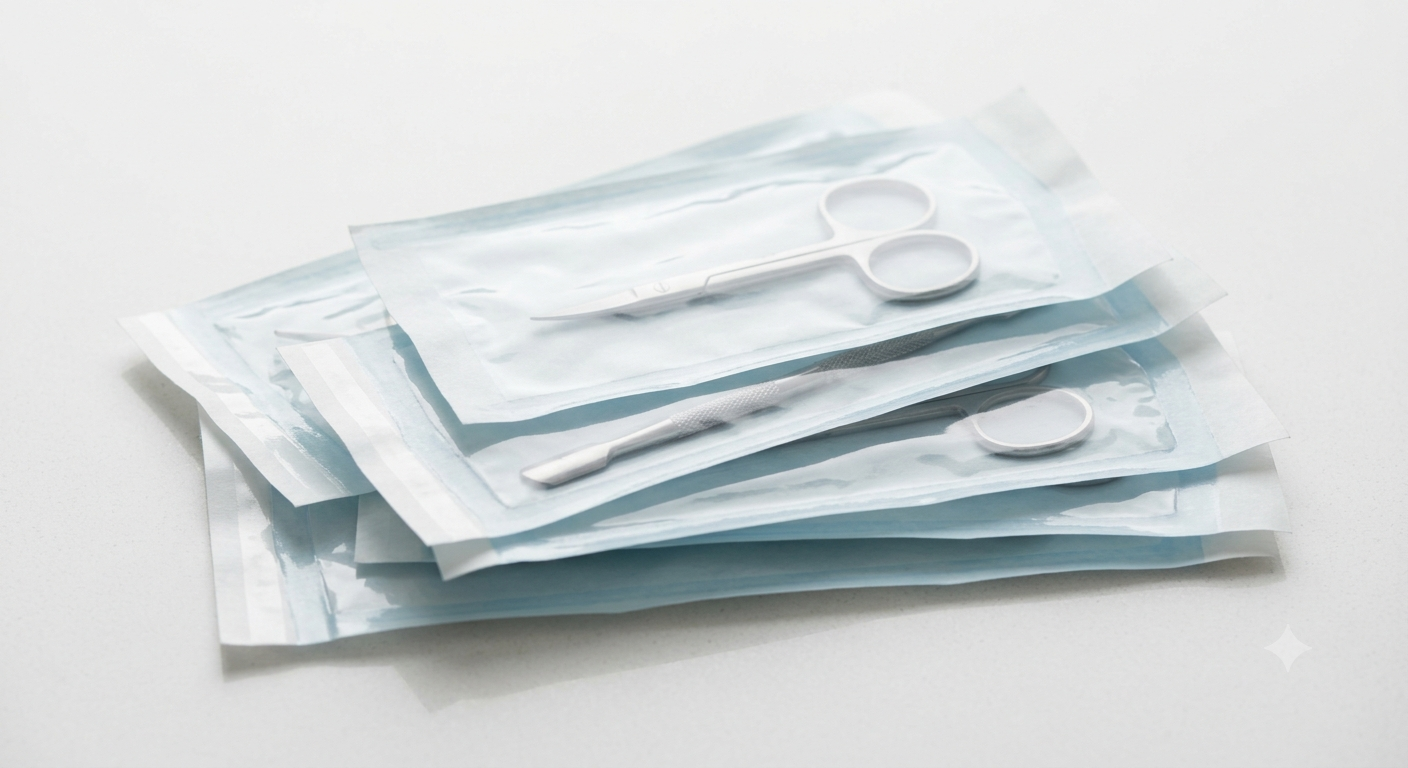
E-file bits follow the same logic, with one added detail: dust and small particles get trapped in the grooves, and if they're not brushed out separately before immersion, the solution never reaches the metal underneath that layer. For a tech with a heavy client load, it's worth keeping several bit sets in rotation — otherwise processing time inevitably gets cut short in the name of speed.
Breakage & Shape Problems in 60 Seconds.
No more guessing which product is to blame.

What You Can't Truly Disinfect, No Matter How Hard You Try
Files, buffers, orange wood sticks — any porous material absorbs liquid and skin particles, and bacteria trapped inside stay out of reach of a solution no matter how much of it you use. The rule here has no exceptions: used on one client, thrown away or sent home with them. Never, under any circumstances, reuse them on another person — not even after "wiping down."
The Table and Armrest — Between Every Client, Not Sometimes
Surface disinfection isn't a quick wipe with a cloth — it's a full step: clear away dust and clippings first, then apply disinfectant to the table and armrest, and don't start the next service until the surface has dried. The contact time is listed on the label too, and it's not there for show.
What About Basins and Baths?
In Russian manicure technique, the one exception where a basin comes into play is hand paraffin treatment, if it's included in the service. It has its own hygiene requirements: the paraffin itself doesn't get disinfected between clients the way a liquid does, so manufacturers recommend disposable liner sleeves for the hands, which fully prevent skin from contacting the shared wax. Without a liner, dipping different clients' hands into the same paraffin is not acceptable. The heater itself and its lid still need to be wiped down and disinfected on the outside, following the standard surface protocol.
The Technician's Own Hygiene
Hands get washed with soap before and after every service — this isn't optional, and it isn't "if there's time." Gloves are required when working near broken skin or blood, with a fresh pair for every new client. And double-dipping — putting a used applicator back into a shared product container — is never acceptable: one instance of it turns that container into a contamination source for every client who comes after.
Dust, Ventilation, and What Often Gets Forgotten
Filing dust and fumes from liquids — primer, degreaser, polygel slip solution — need an extraction system or dust-capture setup right at the workstation. This isn't a comfort question, it's a workplace-safety requirement, even when the air seems fine. A respirator when needed is also part of the protocol, not an overcautious extra.
If an Inspector Shows Up
In most jurisdictions, a salon needs to be able to document that processing happens consistently: a disinfection log with date, time, and signature — for tools and, if used, the paraffin heater; manufacturer instructions for disinfectants and safety data sheets kept accessible. And if an inspector does show up: hand over documents and licensing calmly, and don't try to hide a small issue — fixing it on the spot is almost always easier than explaining it away once it's been found.
The Bottom Line
The clean-disinfect-and-when-needed-sterilize protocol isn't bureaucracy for its own sake — it's the only way to guarantee a service doesn't become a source of infection. For a Russian manicure tech, this is an especially sensitive point: the work happens right up against living tissue, so any gap in tool processing hits the client directly. Before opening your practice, check your own regulator's requirements, and keep your processing protocol just as sharp as the technique itself.
The Tool & Workstation Disinfection Checklist