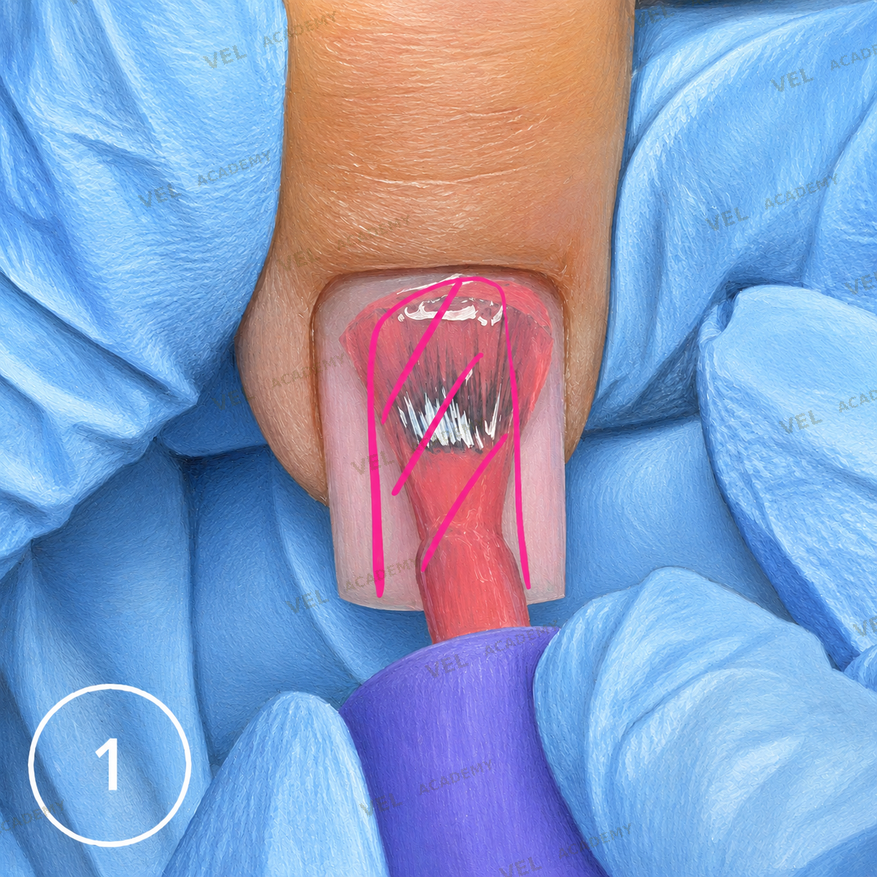
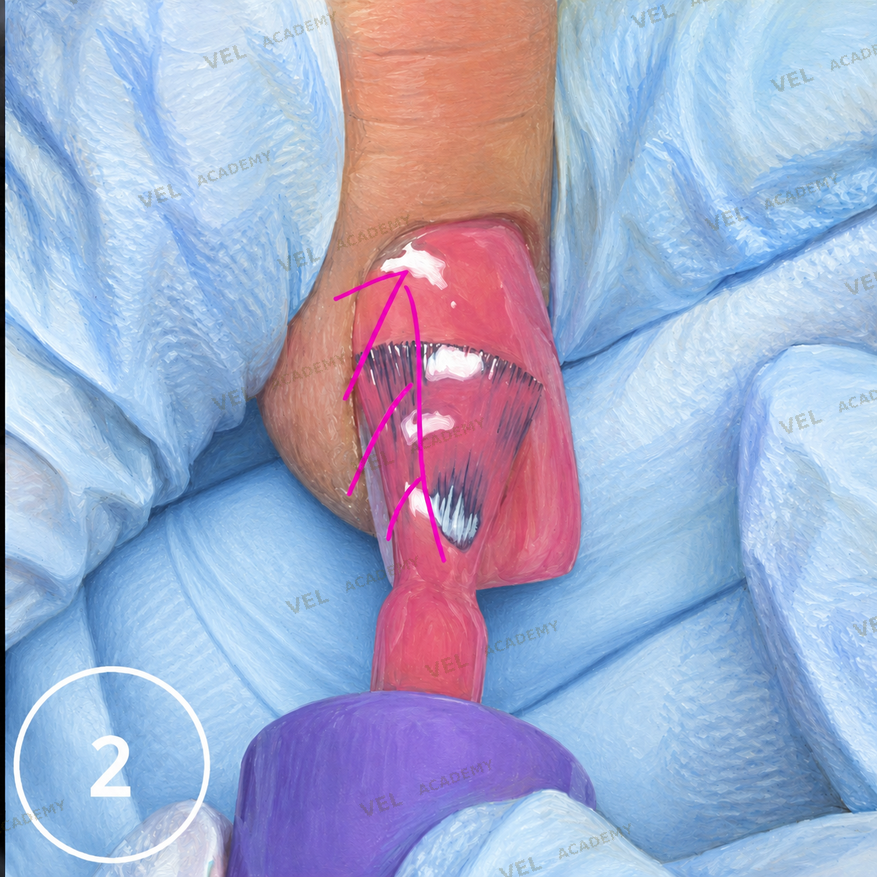
The 3-Stroke Application Sequence
Stroke 1 — Center
One stroke down the center of the nail with a lightly loaded brush. The brush should have enough product to leave a visible, even coat across the center without any dry drags — but not so much that the product pools or spreads beyond the intended zone under its own weight.
Stroke 2 — Left Lateral Wall
Brush angle changes slightly to lay flat against the lateral wall surface rather than sitting on top of the nail. This angle change is what delivers product to the wall surface rather than just the top edge of the nail. Without this angle, the lateral wall remains thinner than the center — which shows as a colour difference when the nail is viewed from the side.
Stroke 3 — Right Lateral Wall + Final Smooth
Right wall mirrors stroke 2. After stroke 3, one final smoothing stroke runs across the full nail surface from growth zone to free edge — not adding product, just leveling any minor thickness variation between the three strokes. This smoothing stroke is what creates the even, consistent surface that the second layer will adhere to. After this stroke the nail goes under the lamp.
Why "Squeezed" Is a Technique, Not a Restriction
A squeezed brush means removing excess product from the brush before it touches the nail — typically by pressing the brush lightly against the inside lip of the gel polish jar as you withdraw it. This is a standard technique in many coating systems, but it is particularly important for the first colour layer in Russian manicure because the leveling gel surface is smooth and even, and a correctly applied first coat should not disturb that evenness.
An overloaded brush leaves product that redistributes under its own weight as it settles. On a freshly cured leveling gel surface, this redistribution creates a first layer that is thicker at the lowest points of the nail architecture and thinner at the highest points — the opposite of what the second layer needs.
Common error: loading the brush heavily for the first coat in order to achieve opacity in one pass. This does not work — gel polish pigment requires two correctly applied coats for full opacity regardless of how densely the first coat is applied. A dense first coat does not reduce the number of coats needed; it creates structural problems that the second coat cannot fix.
Lateral Wall Coverage: Why It Is Part of the First Layer
Both colour layers in VEL Academy technique include lateral wall coverage — not just the center and cuticle zone. The lateral walls of the nail are visible in normal hand position, and colour that does not reach the walls creates a sheer or pale edge that is immediately noticeable compared to the pigmented center.
Lateral wall coverage in the first layer is lighter than in the second — the lightly loaded brush naturally carries less product to the walls. This is appropriate: the first layer's job at the lateral walls is to establish contact and prevent bare patches, not to build density. The second layer builds the density.
The two-layer structure: in VEL Academy colour application, the first layer establishes even coverage and lateral contact with a light brush load. The second layer builds pigment density, wraps the cuticle zone with a fine brush, and produces the final opacity. These are different roles — and trying to combine both functions into one coat produces neither well.
Frequently Asked Questions
Why use a squeezed brush for the first gel polish layer?
VEL Academy recommends a lightly loaded brush because a thin first coat creates a uniform adhesion surface for the second layer. A dense first coat creates thickness variation, can trap air between layers, and produces unevenness that shows through the second coat.
Does a thin first coat mean the colour won't be opaque enough?
No. The first coat is not intended to achieve opacity — that is the role of the second layer. Full opacity is achieved across both layers together. A dense first coat in an attempt to achieve single-coat opacity creates structural problems the second coat cannot fix.
How many strokes does the first colour layer use?
In VEL Academy technique: center, left lateral wall, right lateral wall — followed by one smoothing stroke across the full surface before curing. Three coverage strokes plus one finishing smoother.
Why does lateral wall coverage in colour matter?
Colour applied only to the top surface and not the lateral walls creates a sheer edge visible when looking at the nail from the side. Lateral wall coverage in both layers ensures consistent pigment density from edge to edge.
Should I cure between colour layers?
Yes. In VEL Academy technique, the first colour layer is cured before the second is applied. Applying the second over an uncured first creates mixing between coats, affecting colour density and surface evenness.