The 5-Step Sequence
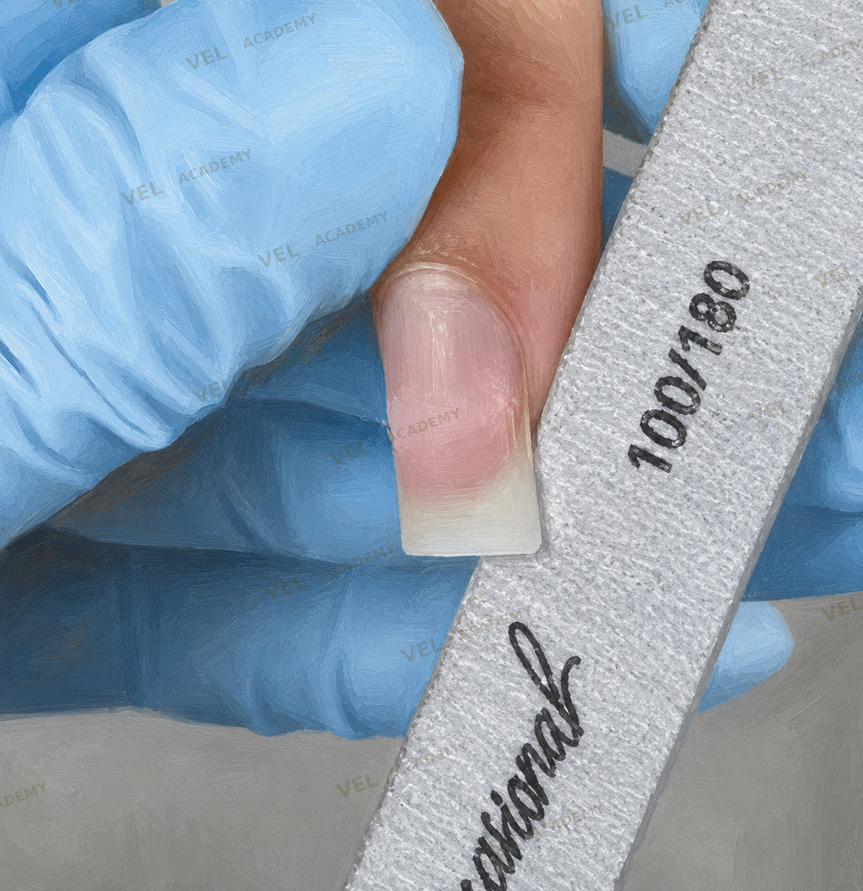
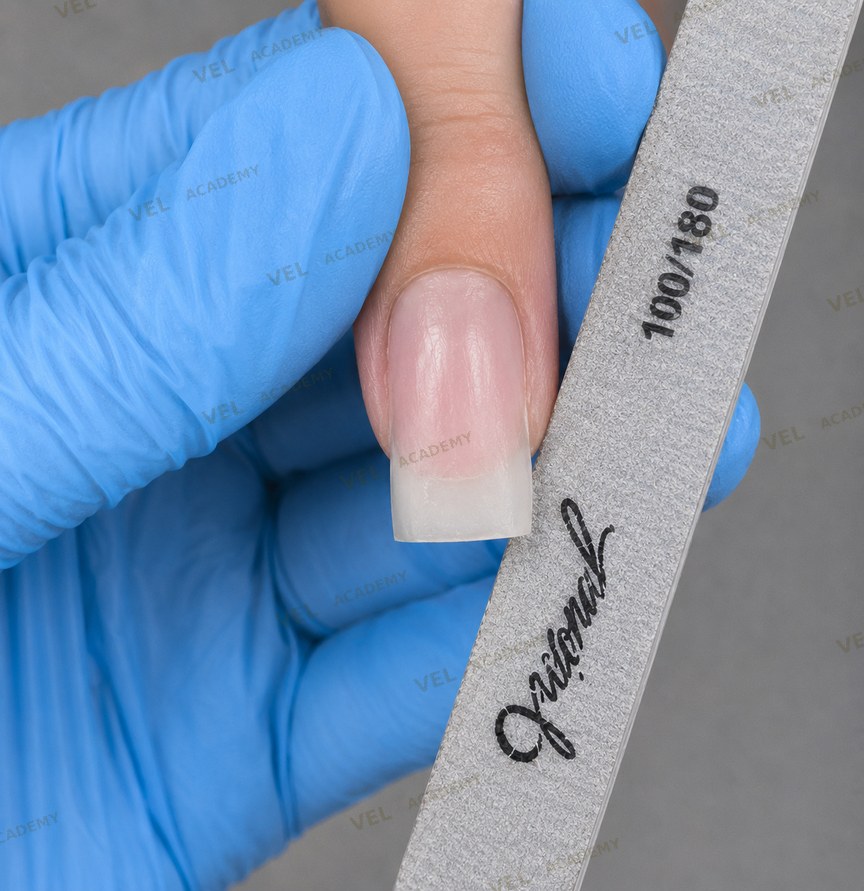
Step 1 — Free Edge at 90°
Position the file at 90° to the tip of the nail and use the edge of the file as a visual guide. The most common error at this stage is letting the file angle drift — tilting toward the client or away — which makes the free edge look tapered rather than flat when viewed from the front. The file edge is the guide: keep it parallel to the free edge surface and move straight across without angle change.
Step 2 — Left Lateral Overhang in Flat Position
Slide the file flat under the entire free edge, resting on it, and move in a flat position — as if the file is lying on a table surface that runs along the lateral wall. This flat position is the technique that prevents roll-off: when the file is flat against the lateral wall, it removes the overhang without altering the 90° angle established in step 1. If the file is angled upward at all during this movement, it bevels the corner rather than removing the overhang cleanly.
Step 3 — Right Lateral Overhang in Flat Position
Mirrors step 2 on the right side. Both lateral walls are now clean and the overhangs are removed without disturbing the free edge angle. After step 3, the nail has a flat free edge and clean lateral walls — but not yet defined corners. Steps 4 and 5 create the corners.
Step 4 — Left Corner Sharpness
Work in one spot at the left corner with back-and-forth strokes, using the edge of the file as a guide. The file edge targets the transition between the free edge and the left lateral wall — precisely where the corner forms. Even pressure and a consistent file position (not drifting along the free edge or the lateral wall) create a sharp corner. This step is performed in one spot, not along the full length of either wall.
Step 5 — Right Corner Sharpness
Mirrors step 4 on the right corner. After this step the shape is complete — a flat free edge, clean lateral walls, and defined sharp corners. The nail is ready for surface e-file filing to remove any volume ridges at the lateral walls from the shape filing strokes.
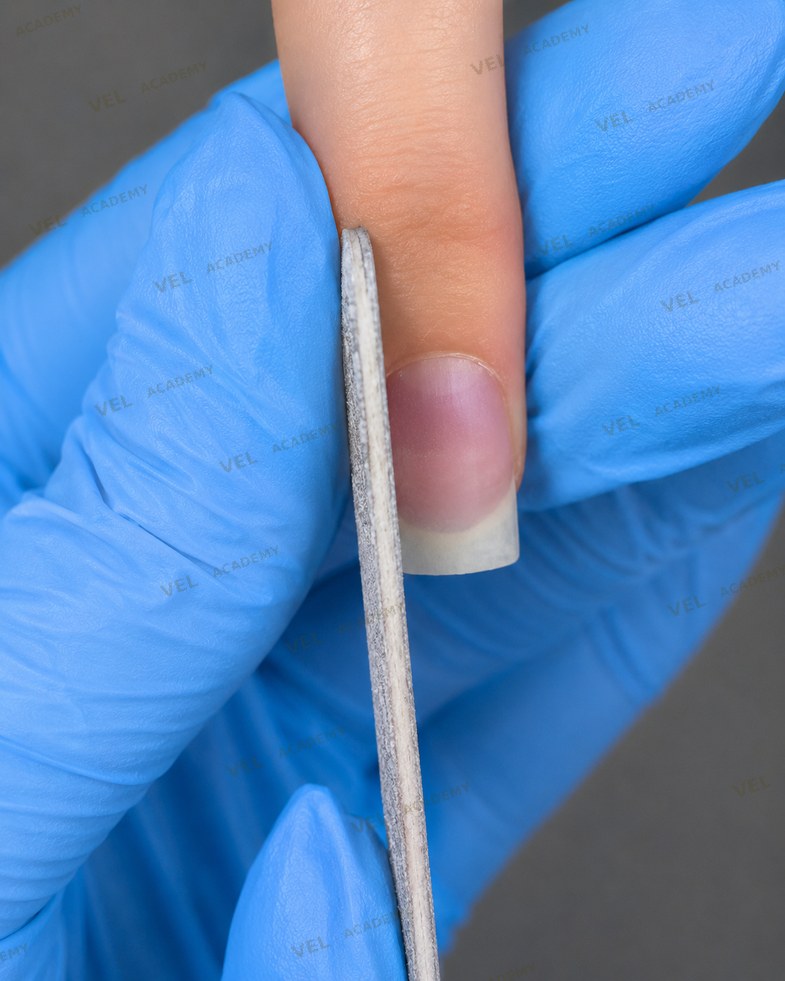
Completed square shape — flat free edge, sharp corners, no roll-off
Why defined sequences produce faster results: In VEL Academy Russian manicure technique, every stage of the service — including shape filing — follows a defined step sequence. This is not about working faster within each step. It is about eliminating the reassessment, backtracking, and correction work that improvised filing produces. The cumulative effect of removing unnecessary work across every stage is the up to 30% service efficiency improvement that VEL Academy technique delivers.
The Flat Position: Why It Prevents Roll-Off
Roll-off is the result of the file contacting the corner of the nail at an angle rather than flat along the lateral wall surface. When the file is held at even a slight upward angle during steps 2 and 3, it bevels the edge of the free edge rather than removing only the lateral overhang. Over multiple strokes, this bevel accumulates into visible roll-off at the corners.
The flat position — file resting on the free edge surface, moving parallel to the lateral wall — physically prevents this. The free edge becomes the reference surface that controls the file angle, just as the free edge was the reference surface in the oval shape lateral wall steps. When the file rests on its reference surface throughout the stroke, the angle cannot drift.
The difference between square and soft square: a true square shape (steps 1–5 above) has fully defined corners where the free edge and lateral walls meet at close to 90°. A soft square has slightly rounded corners — produced either intentionally or by insufficient corner work in steps 4–5. In VEL Academy technique, the distinction between these shapes is made explicitly with the client before filing begins — not decided by how far the technician takes steps 4 and 5.
Common error in step 1: using the full flat surface of the file rather than its edge as the guide for the free edge stroke. The full flat surface is wider than the free edge — it contacts the lateral walls during the stroke and begins to bevel the corners before steps 2–5 have a chance to address them. In VEL Academy technique, step 1 uses the edge of the file — the narrow profile — as the guiding surface.
Frequently Asked Questions
How do you file a clean square nail shape with a hand file?
VEL Academy's 5-step sequence: (1) free edge at 90° using the file edge as guide; (2) left lateral overhang in flat position; (3) right lateral overhang in flat position; (4) left corner sharpness with back-and-forth strokes; (5) right corner sharpness. Result: flat free edge, clean lateral walls, sharp corners, no roll-off.
What causes roll-off in square nail shapes?
Roll-off is caused by the file angle drifting upward during lateral overhang removal — bevelling the edge of the free edge rather than removing only the overhang. The flat file position in VEL Academy steps 2 and 3 prevents this by using the free edge as the angle reference throughout the stroke.
Why does the file need to rest on the free edge during lateral overhang removal?
The free edge is the reference surface. When the file rests on it, the angle is fixed and cannot drift. If the file lifts off, the angle changes and the overhang is removed unevenly — creating asymmetry in the final shape.
How do you create sharp corners on a square nail shape?
In VEL Academy technique: back-and-forth strokes using the file edge as a guide, working in one spot at the lateral wall corner. Steps 4 and 5 target precisely the transition between free edge and lateral wall — where the corner forms.
Is square harder to file than oval?
They require different technique. Square requires angle control and corner precision. Oval requires rocking motion and symmetrical curve management. In VEL Academy technique, both have defined sequences that make them reproducible — the difficulty comes from improvisation, not from the shape itself.