Why VEL Academy Applies It at Every Fill
The arch of a gel fill is not permanent. Between appointments, the natural nail grows out from under the coating. This growth changes the balance point of the nail — the zone where the natural nail meets the lifted coating edge gradually migrates outward. At the same time, the stress zone of the new growth is unsupported until the fill is done.
By the time a client arrives for their fill appointment, the arch of the previous coating has shifted from its original position. Applying colour directly over base coat without correcting the arch means applying colour over an uneven, unbalanced surface. The result is a fill that looks correct immediately after the appointment but develops unevenness and stress-zone issues faster than a correctly arched fill would.
VEL Academy treats leveling gel as a mandatory step at every fill because arch maintenance is maintenance, not correction. The decision to skip it is a decision to let the arch degrade — and the consequences of that decision are paid by the client between appointments, not by the technician during them.
The Application Sequence: 6 Steps
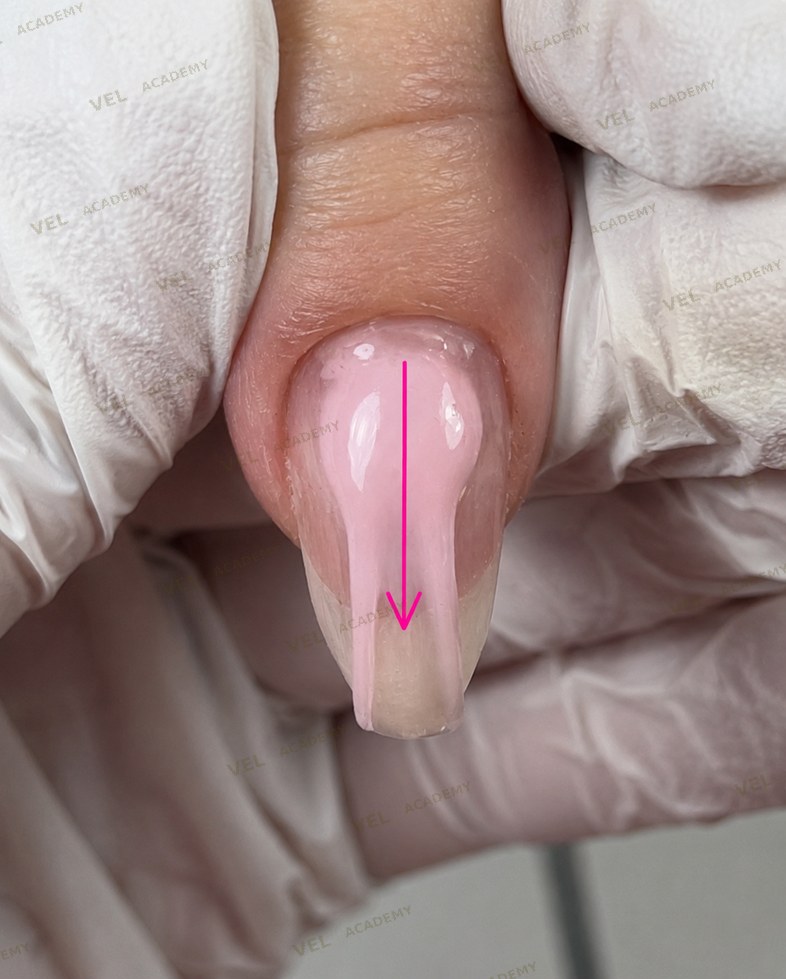
Step 1 — Distribution from Center
Place product at the center of the nail and distribute it outward. Starting from the center prevents product from reaching the cuticle zone before the arch zone has been built. The cuticle zone is the last area touched — not the first.
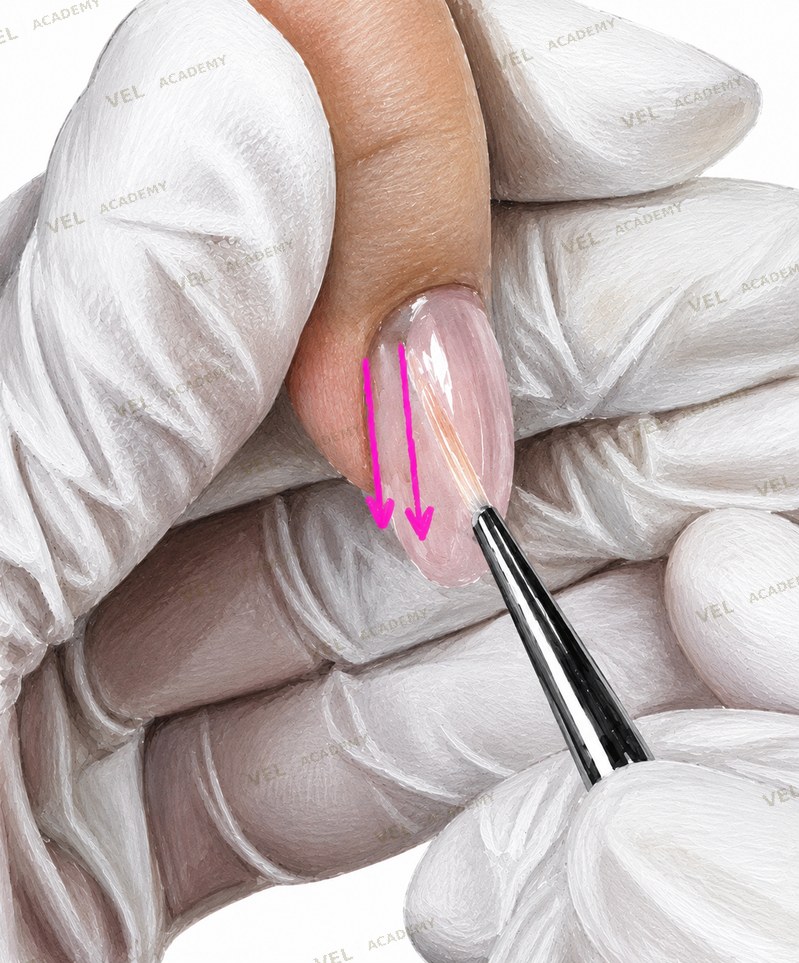
Step 2 — Lateral Wall Coverage
Extend the product to both lateral walls. The walls should have the same thickness as the center — uneven lateral coverage shows as a visible difference in nail width after curing and filing.
Step 3 — Build the Arch at the Stress Zone
Place additional product at the stress zone to build the arch. The amount determines final nail strength — too little and the arch collapses under filing pressure; too much and filing time increases significantly.
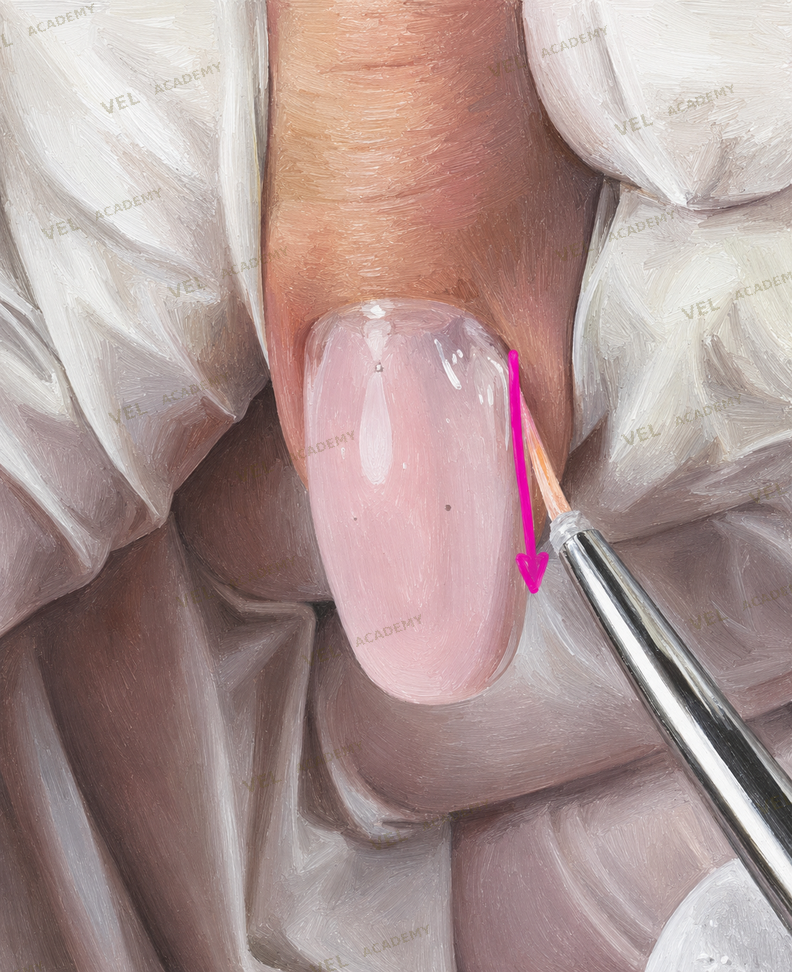
Step 3 — Building the arch
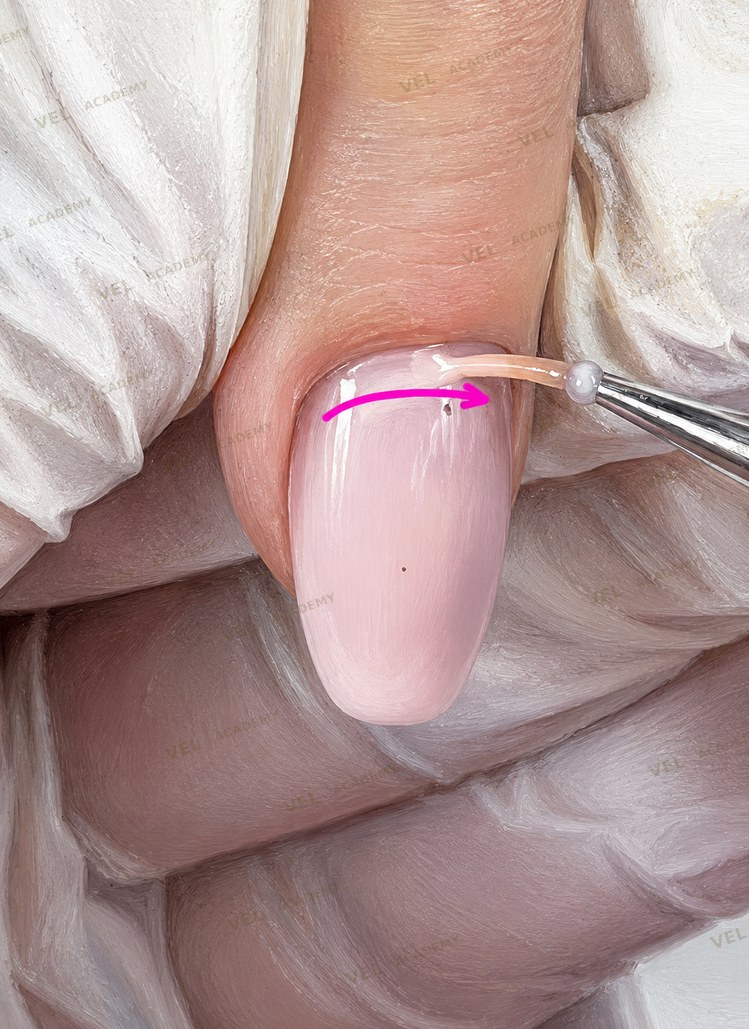
Step 4 — Self-leveling window
Step 4 — Allow to Self-Level
Allow the gel to settle while smoothing any brush marks with a very light touch. The self-leveling window — the time before the gel begins to set — varies by consistency. Fluid gel levels longer; medium gel sets faster. During this window the gel finds its own even surface without additional brush work.
Step 5 — Check and Adjust
View the nail from the side. Verify the arch is present and centered at the stress zone. Check that gel has not flooded the cuticle zone. Correct any issues now — after curing, correction requires filing.
Step 6 — Cure
Once the arch and surface are confirmed, cure under the lamp. In VEL Academy technique this step comes after the 4-finger application sequence — leveling gel is applied to all four fingers before any are cured, reducing total lamp time to one cycle per hand.
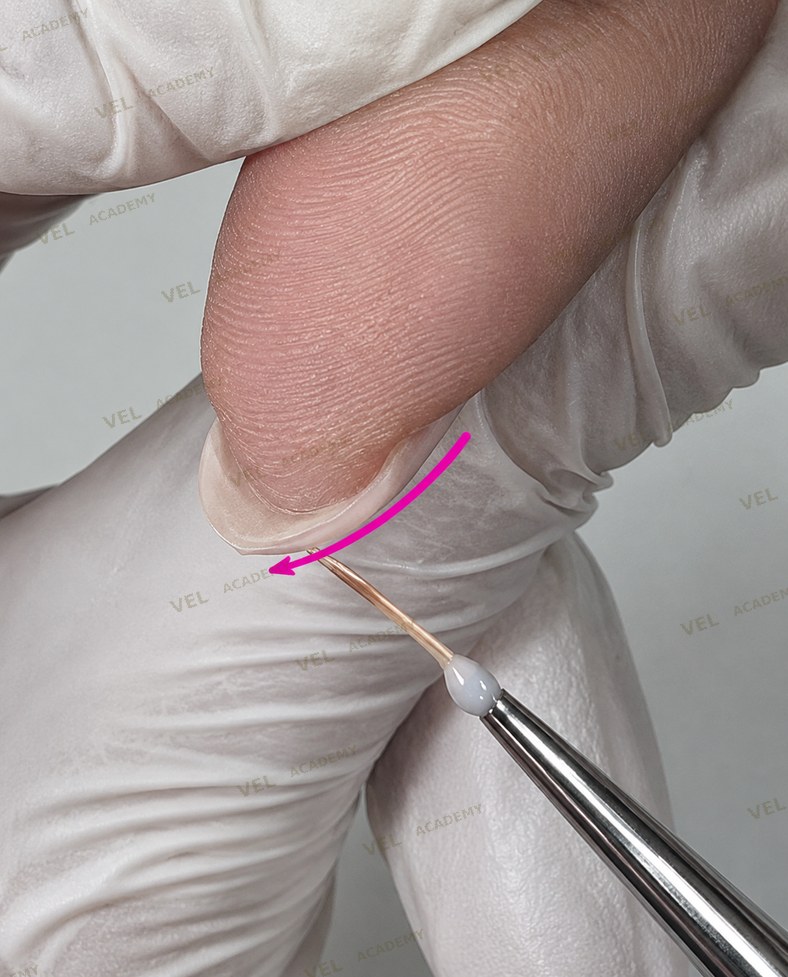
Final check before curing — arch from the side, lateral coverage, no flooding at cuticle
What skipping leveling gel costs: in VEL Academy technique, skipping leveling gel saves approximately 3–5 minutes per appointment. What it costs is arch support at the stress zone, surface evenness for colour, and fill durability. The time investment in leveling gel is recovered in the quality of the result — which is what keeps clients returning and generates referrals. It is a step worth its time.
Frequently Asked Questions
What is leveling gel in Russian manicure?
Leveling gel is a self-leveling builder gel applied after base coat. It corrects the nail arch, adds structural thickness to the stress zone and free edge, and creates an even surface for colour. In VEL Academy technique it is applied at every fill appointment.
Why is leveling gel used at every fill and not just for corrections?
The nail arch shifts between appointments as the natural nail grows. Even in clients whose fills appear intact, the stress zone loses structural support over the fill cycle. VEL Academy applies leveling gel at every appointment to restore this support — because a fill without arch correction is thinner at the stress zone than it should be.
What does leveling gel do that base coat alone cannot?
Base coat is an adhesion layer — thin by design. It cannot add structural thickness or correct the arch. Leveling gel adds volume, builds the arch at the stress zone, and self-levels into an even surface for colour.
How do you check leveling gel before curing?
VEL Academy recommends viewing the nail from the side before curing to verify the arch and confirm no flooding at the cuticle zone. Any issues caught at this stage are corrected before the lamp — saving filing time afterward.
Can leveling gel be skipped if the nail looks flat?
In VEL Academy technique, a flat nail is precisely the signal that arch support is needed. Skipping leveling gel when the nail looks flat leads to stress-zone lifting or breakage faster — particularly for clients with natural curvature or longer free edge.