Oval Nail Shape with E-File: 7 Steps from Shortening to Final Rounding — VEL Academy — Part 1

Nail Shape · Oval

Oval Nail Shape in Russian Manicure: The 7-Step Filing Sequence from Overhang to Final Curve

VEL Academy methodology: The 7-step oval shape sequence described in this article is VEL Academy's recommended approach for consistent, symmetrical oval results. Other schools may use different step orders or tools. What is described here is the system that produces reproducible oval shapes across different nail lengths and client hand presentations.

Oval nail shape looks simple — it is a curve. But a correctly filed oval is the product of a specific sequence where each step creates the conditions for the next. Rounding the free edge before aligning the lateral walls produces an asymmetrical oval. Skipping the final 45° pass produces a shape that looks unfinished from the side. In VEL Academy Russian manicure technique, the 7-step sequence makes a consistent oval repeatable rather than accidental.

Why Sequence Matters More Than Technique in Shape Filing

Most shape filing errors are not execution errors — they are sequence errors. The technician makes the right movements in the wrong order, which means each step creates problems for the next rather than building on the previous one. The oval shape is particularly sensitive to this because the final curve is determined by the symmetry established in the overhang alignment steps — and symmetry cannot be recovered after rounding has begun.

The 7-step sequence in VEL Academy technique is designed so that every step either creates a prerequisite for the next or corrects a residual from the previous. Nothing is decorative and nothing is redundant. Understanding the function of each step is what allows the technician to adapt it to different nail lengths and presentations without losing the logic of the sequence.

Steps 1–4: Preparation Before Rounding

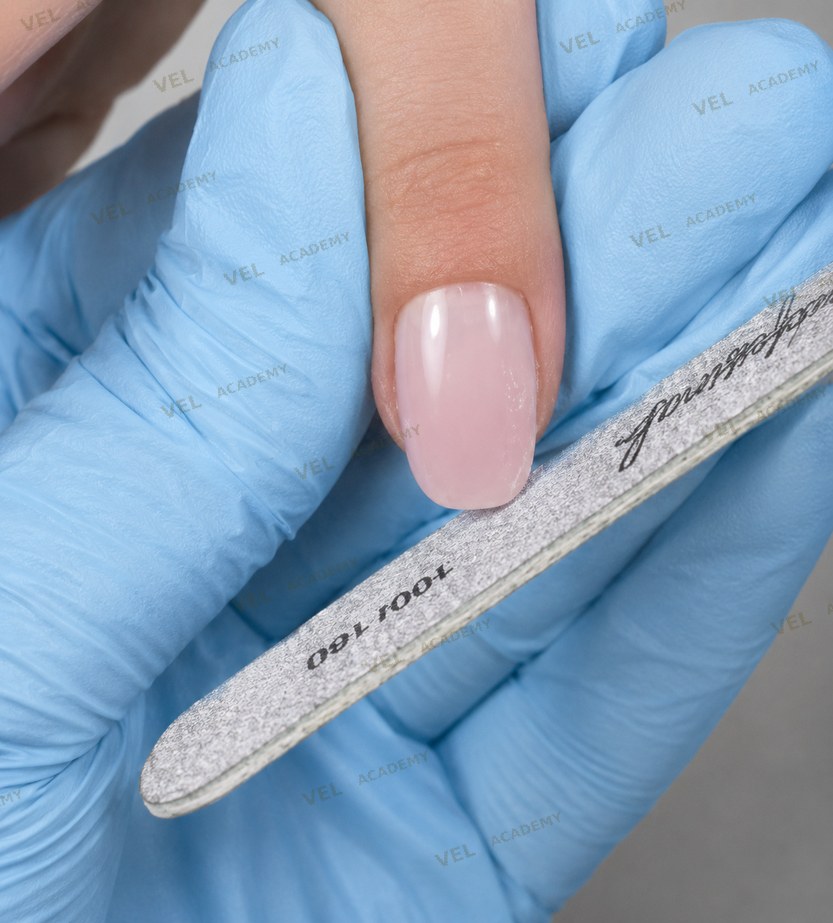
Step 1 — Shorten Length if Needed

If the client's nail is longer than the target length, shorten it first — before any shaping work. Attempting to shorten and shape simultaneously creates an unpredictable free edge angle and makes overhang alignment in step 2 unreliable. Length reduction comes first, shape work comes after.

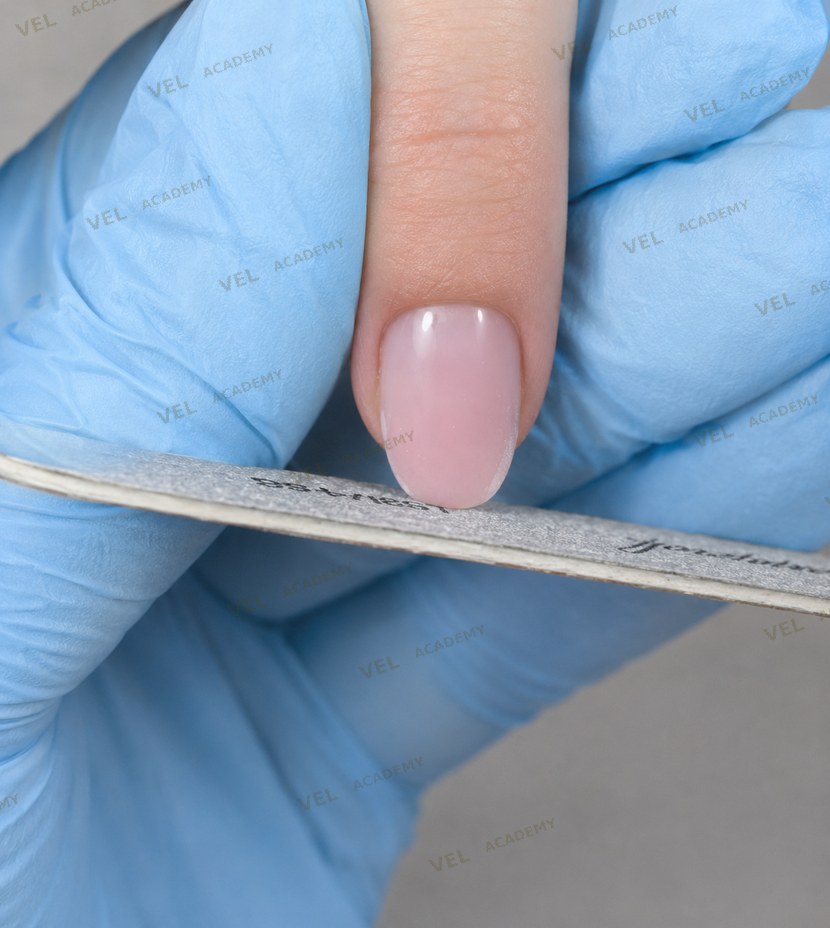
Step 2 — Visual Overhang Alignment

Compare the coating overhang on both lateral walls and bring them to the same level. This is a visual check: look at the nail from above and identify which side has more overhang. File the side with more overhang until both sides match. This step is the symmetry foundation — any asymmetry here becomes permanent asymmetry in the final oval shape.
Comparing and aligning coating overhang on both lateral walls before oval shape filing

Step 2 — Visual alignment: both overhangs must match before rounding begins

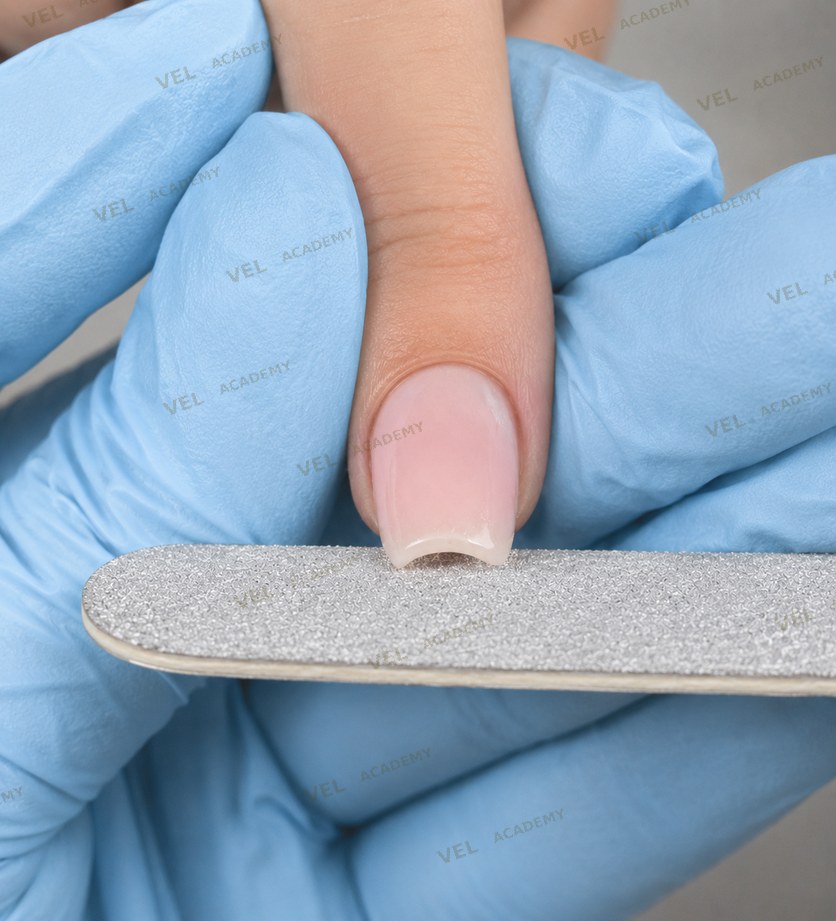
Step 3 — Remove Right Lateral Overhang

File the right lateral wall overhang with the file held parallel to the wall and resting on the free edge throughout the stroke. The contact point of the file on the free edge is the reference — if the file lifts off the edge during the stroke, the wall angle changes and the symmetry established in step 2 is lost.
Filing right lateral wall overhang parallel to wall resting on free edge oval shape

Step 3 — Right lateral overhang removal: file parallel to wall, resting on free edge

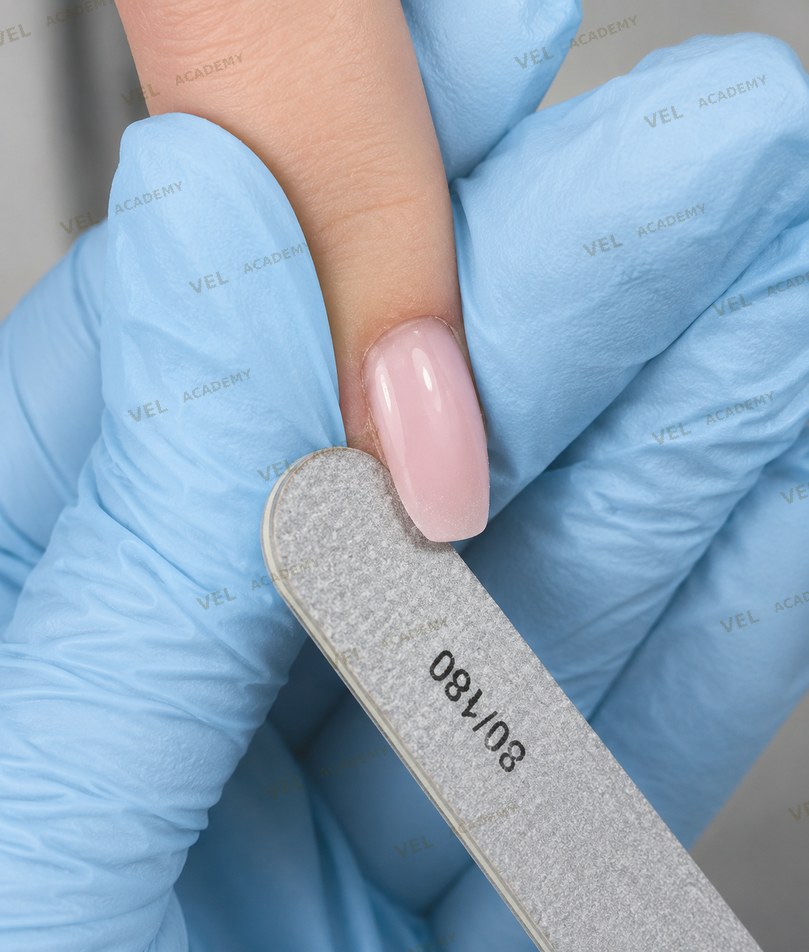
Step 4 — Remove Left Lateral Overhang

Mirrors step 3 on the left side. Consistent pressure and file angle on both sides is what maintains the symmetry from step 2 through to the rounding stage. After step 4, both lateral walls are clean and at the same level — the nail is ready for rounding.
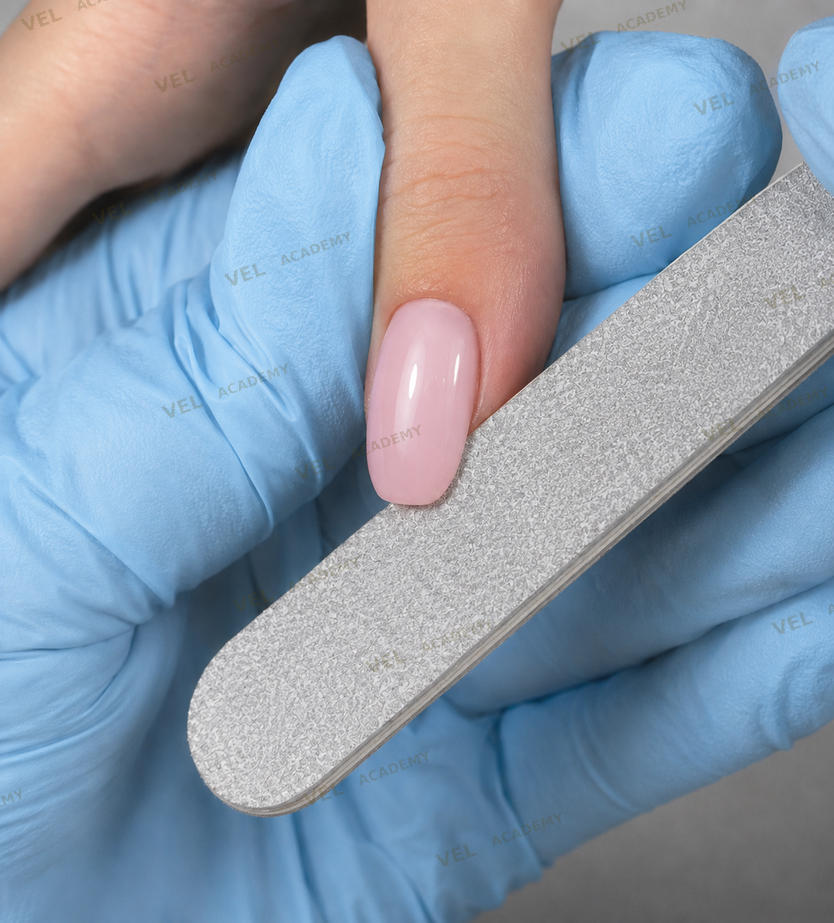
Filing left lateral wall overhang parallel to wall oval nail shape step 4

Step 4 — Left lateral overhang: same technique as step 3, consistent angle

Free Nail Diagnosis Map – Stop Lifting,
Breakage & Shape Problems in 60 Seconds.
GET IT NOW.
This Diagnosis map is a practical troubleshooting tool for nail techs. It helps you identify the most likely cause of common failures and apply a First Fix (the smallest change with the biggest impact).
Oval Nail Shape with E-File: 7 Steps from Shortening to Final Rounding — VEL Academy — Part 2

Steps 5–7: Rounding and Finishing

Step 5 — Round the Free Edge with Rocking Motions

Round the free edge using rocking motions of the file — left and right — rather than straight strokes. The rocking motion follows the intended curve of the oval, creating a smooth, even arc without flat spots. Work from one lateral corner, across the center, to the other corner. The file angle adjusts continuously to follow the curve rather than staying fixed.

Rocking motion file technique rounding free edge oval nail shape step 5

Step 5 — Rocking motion, left and right across free edge

Checking and rounding center of oval nail shape rocking motion step 6

Step 6 — Center check and rounding

Step 6 — Check and Round the Center

After rounding both sides, look at the center of the free edge. Any remaining straight or flat area at the peak of the curve is addressed here with the same rocking motion, focused on the center zone. This step reveals asymmetry between the left and right curves — if one side is more rounded than the other, it is visible at the center comparison point.

Step 7 — Final 45° Pass Over Lateral Wall Overhangs

Hold the file at 45° and run it over the lateral wall edges — the thin ridge of coating that remains along the lateral walls after rounding. This ridge is a residual from the rounding step: as the file curves the free edge, it leaves a slight shelf at the point where the free edge meets the lateral wall. The 45° pass removes this shelf and creates a clean, finished profile when the nail is viewed from the side.

Final 45 degree file pass over lateral wall overhangs oval nail shape last step

Step 7 — Final 45° pass: the step that finishes the oval shape

Why step 7 is the most skipped step: the lateral wall shelf left by the rounding process is not obvious from above — it requires viewing the nail from the side to see clearly. Most technicians check their oval shape from above and call it done. In VEL Academy technique, the side view check is mandatory before the appointment is complete — and the 45° pass is what the side view is checking for.

Why defined sequences produce faster results: In VEL Academy Russian manicure technique, every stage of the service — including shape filing — follows a defined step sequence. This is not about working faster within each step. It is about eliminating the reassessment, backtracking, and correction work that improvised filing produces. The cumulative effect of removing unnecessary work across every stage is the up to 30% service efficiency improvement that VEL Academy technique delivers.

The Speed Connection

A 7-step sequence sounds slower than an improvised approach — but it is faster in practice because each step is defined and complete. There is no reassessment mid-shape, no backtracking to fix symmetry after rounding has started, and no uncertainty about what comes next. In VEL Academy Russian manicure technique, defined filing sequences are part of the same efficiency principle that applies across the full service — precision at each step eliminates correction work, and the cumulative effect of eliminating correction is where the up to 30% service time reduction comes from.

Common error: beginning to round the free edge before completing the overhang alignment in step 2. Once rounding has started, the reference points for overhang comparison change — the oval is now being shaped around an asymmetrical base. This is the source of most oval shapes that look correct on one side and slightly off on the other.

Frequently Asked Questions

How many steps does the oval nail shape filing sequence have?

VEL Academy's oval sequence has 7 steps: shorten length, align overhangs visually, remove right overhang, remove left overhang, round with rocking motions, check and round center, final 45° pass over lateral walls.

What is the rocking motion for oval nail shape filing?

A left-right movement of the file across the free edge, following the intended curve of the oval. The file rocks from one side to the other rather than moving in straight strokes — this creates a smooth, even curve without flat spots or angular corners.

Why must overhang be aligned on both sides before rounding?

Asymmetrical overhangs before rounding produce an asymmetrical oval — the side with more overhang appears wider. Symmetry cannot be recovered after rounding has started. Aligning both sides first makes the asymmetry visible and correctable at the right moment.

What does the final 45° pass do?

It removes the thin ridge of coating remaining along the lateral walls after rounding — visible when the nail is viewed from the side. Without this pass the oval shape has a slight shelf at the lateral wall edges that makes the shape look unfinished.

Should I use an e-file or hand file for oval nail shape?

In VEL Academy technique, length shortening and lateral overhang removal can use an e-file for efficiency. The rounding movements and final 45° pass use a hand file for the control they require.

Professional Course

Master the Oval Nail Shape — In English

VEL Academy's Oval Shape Mastery course teaches the complete 7-step filing sequence — including the overhang alignment and final 45° pass — with full video demonstration on real clients.

View Oval Shape Mastery — $59.99