Nail Plate Preparation Before Base Coat: What It Should Look Like — VEL Academy — Part 1

Coating Application · Nail Plate Preparation

Nail Plate Preparation Before Base Coat: The Five-Point Check VEL Academy Recommends

VEL Academy methodology: The preparation checklist described in this article reflects VEL Academy's recommended standards before base coat application in Russian manicure. Other schools may use different preparation sequences or criteria. What is described here is the framework that underpins adhesion quality in VEL Academy technique.

The most common cause of early lifting in gel fills is not the base coat, the gel, or the lamp — it is the condition of the nail plate at the moment the base coat brush makes contact. Preparation quality determines adhesion quality, and adhesion quality determines how long the fill lasts. In VEL Academy Russian manicure technique, preparation before base coat is not a formality — it is the stage that makes everything that follows work or fail.

Why Preparation Is the Foundation of Fill Durability

Base coat forms a bond with the nail plate surface. That bond depends on surface-to-surface contact — the base coat molecules adhering to the keratin of the nail plate. Any material between the base coat and the nail plate surface — oil, moisture, dust, cuticle adhesions, or residual dead skin — breaks that contact and creates a zone where the bond is weak or absent.

A weak bond zone does not always cause immediate lifting. It creates a starting point — a location where the coating is not fully adhered, where mechanical stress (bending, impact, water exposure) concentrates. When that stress exceeds the bond strength at the weak point, lifting begins. This is why fills that lifted "for no reason" almost always have a preparation problem as their actual cause.
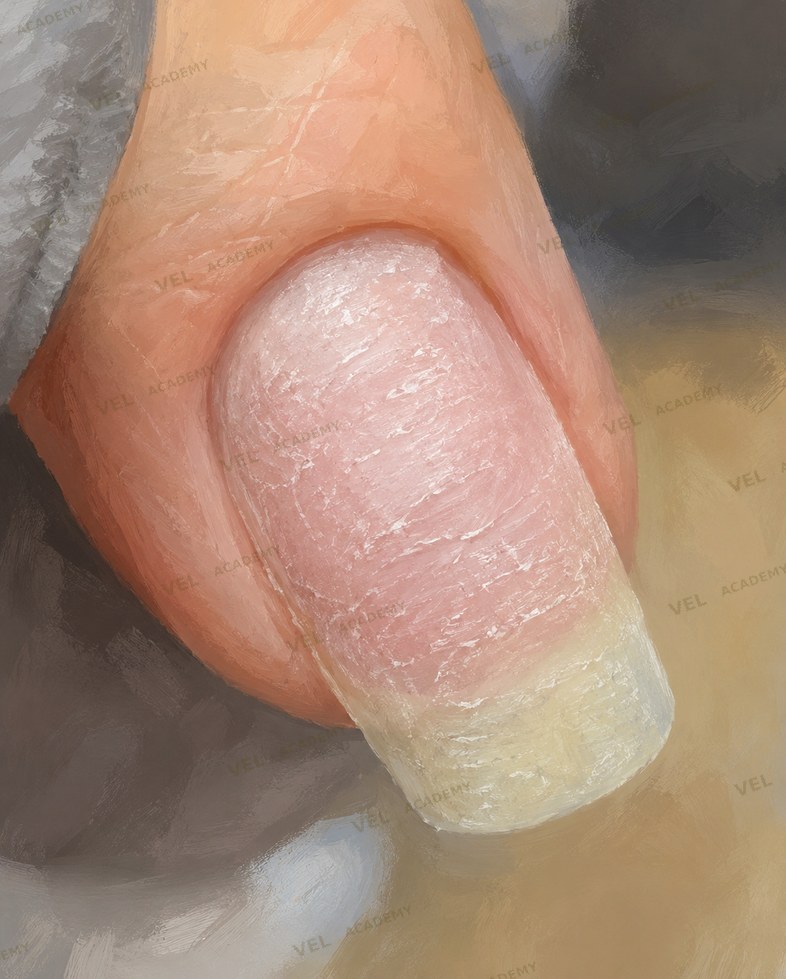
Correctly prepared nail plate before base coat application Russian manicure

Correctly prepared nail plate — ready for base coat
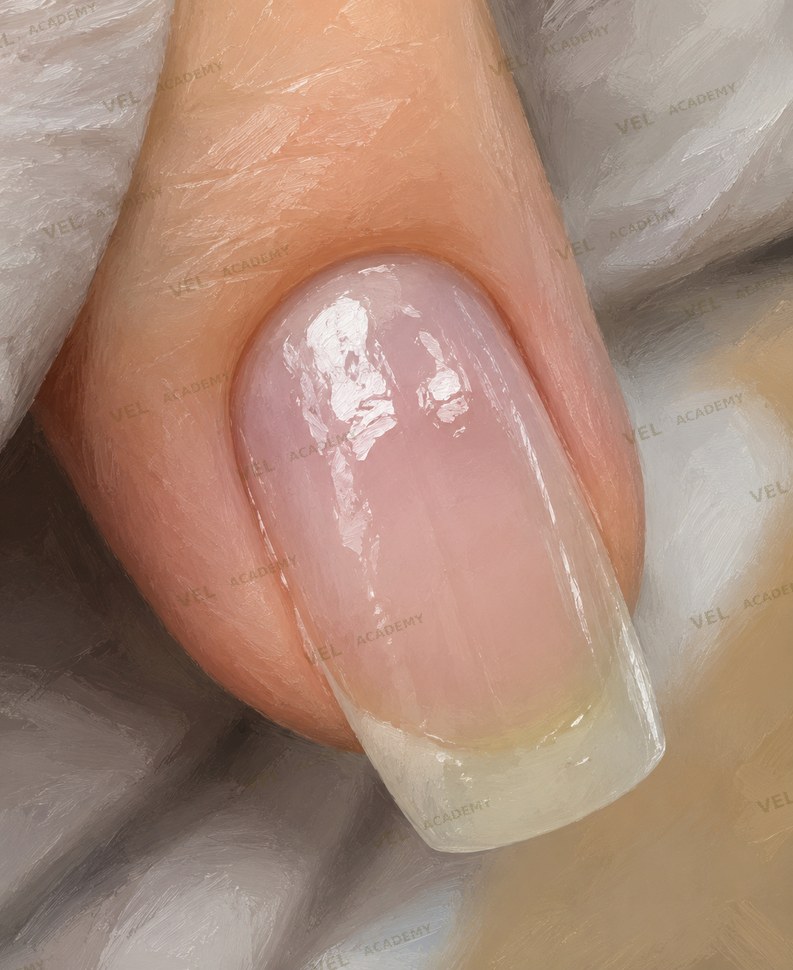
Full nail plate with clean cuticle line and smooth surface before base coat

Clean cuticle line, smooth surface, no adhesions

The Five-Point Preparation Check

In VEL Academy technique, preparation before base coat is assessed against five specific conditions. All five should be present before the brush touches the nail. If any are absent, the preparation stage is not complete.


1
Surface is smooth and even — run a fingertip across the nail plate. It should feel smooth and consistent from the growth zone to the free edge, with no ridges, grooves, or rough patches from the removal stage. If the surface is not smooth, a brief e-file smoothing pass at 10,000–15,000 RPM is needed before proceeding.
2
Growth zone is clear of pterygium and adhesions — visually check the cuticle zone. No dead skin should be adhered to the nail plate surface. The cuticle line should be defined and clean. Any remaining pterygium or adhesion at the growth zone is a direct lifting risk — base coat applied over it will separate at the adhesion point as the skin moves.
3
No lifting zones from previous coating — if the client had lifting, the affected zone needs to be inspected after removal. The nail plate surface under a lifting zone is sometimes disrupted (see the 180-grit file article for details). A disrupted surface needs correction before base coat will bond correctly in that zone.
4
Nail is clean and dry after dehydrating tonic — dehydrating tonic is applied to remove the oil and moisture film from the nail plate surface immediately before base coat. The nail should look matte and dry after tonic application, not shiny. A shiny surface after tonic means the film was not fully removed.
5
Cuticle line is defined and clean — the cuticle line should show a clear separation between the nail plate surface and the surrounding skin. A blurred or ragged cuticle line is a signal that the manicure stage was not completed, which will affect not only the appearance of the base coat but also the adhesion quality at the growth zone.
This Diagnosis map is a practical troubleshooting tool for nail techs. It helps you identify the most likely cause of common failures and apply a First Fix (the smallest change with the biggest impact).
Nail Plate Preparation Before Base Coat: What It Should Look Like — VEL Academy — Part 2

The Role of Dehydrating Tonic and Acid Base

Two chemical preparation steps follow the physical preparation check in VEL Academy technique: dehydrating tonic and acid base (bonding base). Both address aspects of nail plate preparation that visual inspection cannot confirm.

Dehydrating Tonic

The nail plate always has a surface oil and moisture film — even after manicure work and dust removal. This film is invisible but present. Dehydrating tonic dissolves this film and allows it to evaporate, leaving the nail plate surface chemically clean rather than just visually clean. It is applied immediately before base coat — not 10 minutes before, not at the start of the appointment. The window between tonic application and base coat application should be as short as possible to prevent the film from reconstituting.

Acid Base (Bonding Base)

Acid base is applied as a primer layer between the dehydrated nail plate and the structural base coat. In VEL Academy courses, brands such as X-Bond Akzentz, IQ Beauty Medium, Gloss Premium, and Enef are used. The acid base creates a chemical adhesion layer that mechanical preparation alone cannot replicate — particularly important at the growth zone and lateral walls, which are the two highest-risk zones for lifting.

Preparation sequence before base coat (VEL Academy): complete manicure → shape filing if needed → dust removal → dehydrating tonic → acid base (thin layer, fully dry) → structural base coat. Each step assumes the previous one was completed correctly. Skipping any step creates a gap in the adhesion chain.

Common Preparation Errors and What They Cause

  • Skipping tonic or applying it too early — oil film reconstitutes within minutes. Base coat applied to a re-oiled surface has reduced adhesion across the full nail, not just at one zone.
  • Residual dust not removed before tonic — dust particles under the base coat create micro-gaps in the adhesion layer. These gaps are invisible after curing but become lifting starting points.
  • Pterygium remaining at the growth zone — base coat applied over pterygium adhesions lifts as the skin moves. This typically appears as cuticle-zone lifting within the first week.
  • Applying base coat to a shiny nail plate after tonic — a shiny surface means the tonic did not fully remove the oil film, or the nail was touched between tonic and base coat application. Reapply tonic before proceeding.

The most overlooked preparation error: touching the nail plate between tonic application and base coat. Even brief contact with a fingertip transfers oils from the skin to the nail surface. In VEL Academy technique, once tonic is applied, the nail is not touched until the base coat brush makes contact.

What Correct Preparation Looks Like Visually

A correctly prepared nail plate before base coat has a specific appearance that becomes recognisable with experience. The surface looks matte and even — not shiny, not patchy. The cuticle line is clean and shows a clear boundary between nail plate and skin. The lateral walls and growth zone are free of any skin adhesions or residual dead tissue.

This visual standard is worth developing the habit of checking explicitly before the base coat brush moves. In a busy appointment schedule, the temptation is to move directly from tonic application to base coat. The five-point check adds approximately 10–15 seconds and catches preparation gaps that would otherwise result in a callback appointment or a client who stops returning.

Frequently Asked Questions

What should the nail plate look like before applying base coat?

In VEL Academy Russian manicure technique, a correctly prepared nail plate is smooth and even across the full surface, free of cuticle adhesions at the growth zone, free of lifting zones, clean and dry after tonic, and has a defined clean cuticle line. All five conditions should be present before base coat application begins.

Why does nail plate preparation affect how long a gel fill lasts?

Base coat adhesion depends on surface-to-surface contact. Any oil, moisture, dust, or adhesion between the base coat and nail plate creates a weak bond zone — which becomes a lifting starting point under mechanical stress. Correct preparation eliminates those zones before the brush touches the nail.

What does a dehydrating tonic do before base coat?

A dehydrating tonic removes the thin oil and moisture film that naturally covers the nail plate surface. Even after correct manicure work, this film is present and reduces base coat adhesion. Applying tonic immediately before base coat ensures the surface is chemically clean, not just visually clean.

Can I apply base coat without acid base primer in Russian manicure?

In VEL Academy technique, acid base is applied before the structural base coat as a primer layer. It creates a chemical bond between the nail plate and the base coat that mechanical preparation alone cannot achieve — particularly important at the growth zone and lateral walls where lifting most commonly starts.

How do I know if the nail plate is ready for base coat?

VEL Academy recommends a five-point check: (1) surface is smooth tactilely, (2) growth zone is clear of pterygium, (3) no lifting zones remain, (4) nail is clean and dry after tonic, (5) cuticle line is defined. If all five are present, the nail is ready.

Professional Course

Learn the Complete Coating Application System — In English

VEL Academy teaches preparation, base coat, leveling gel, color application, and top coat as a complete system — with the technical reasoning behind every step for licensed nail technicians.

View Complete Bundle — $311.99